
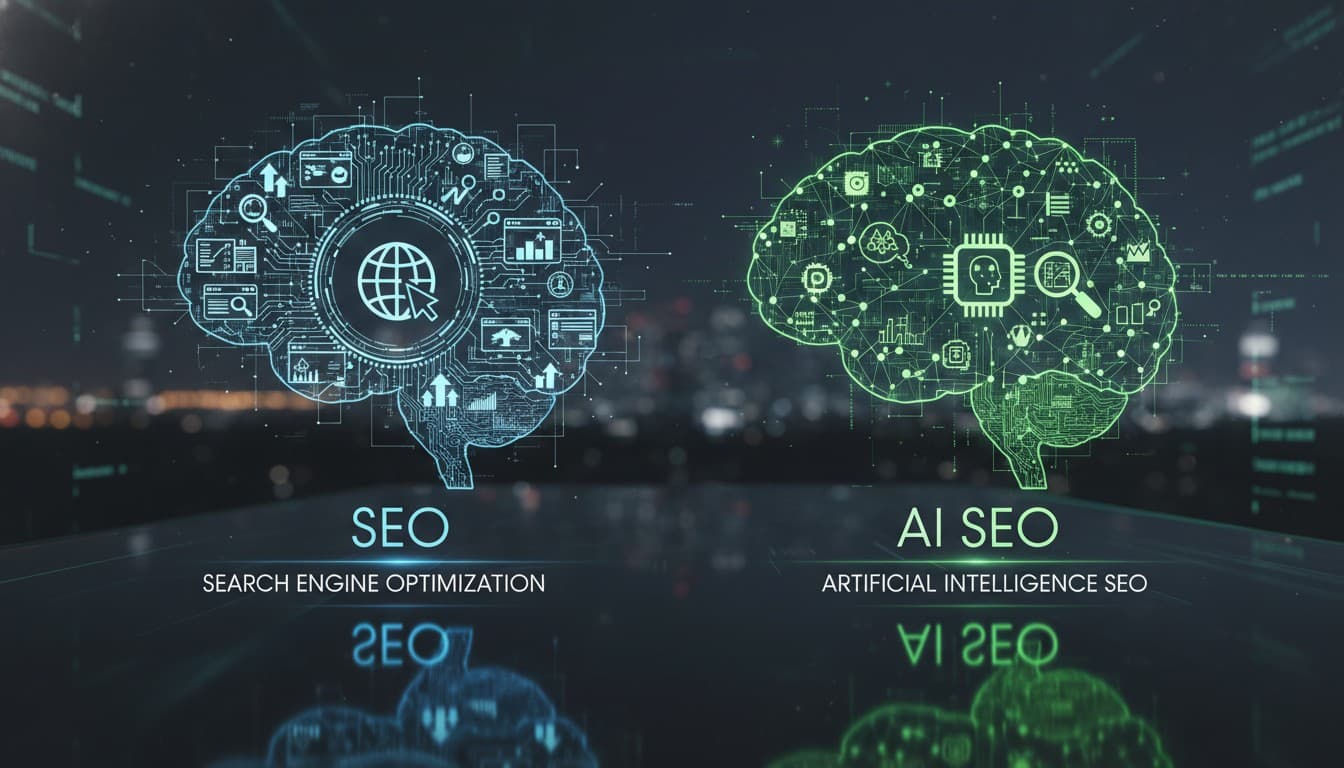
The Evolving Landscape of Search
Do you remember when finding things online meant clicking blue links? That world is changing fast. Today, people ask large AI models, like ChatGPT or Gemini, direct questions. They expect instant, clear answers, not a list of ten websites. This big shift changes how we think about being found online.
This change means we need two sets of skills now. We need Traditional SEO skills, which are still important. But we also need something new: Generative Engine Optimization (GEO).
What is the difference? Think of it this way:
- Traditional SEO is like making sure your book is on the right shelf at the library so someone browsing can find it. It focuses on keywords, links, and page speed.
- Generative Engine Optimization (GEO) is like making sure the librarian reads your book and tells people your book has the best answer when asked a question directly.
We need both. You must keep your website fast and well-linked, but you also need to make sure the AI models trust your brand enough to quote you.
This guide will show you the critical differences between these two approaches. Knowing the gap between Traditional SEO and GEO is the first step to owning your AI presence. We will show you how to start improving your AI standing today.
Being seen by Google is one job. Being quoted by the AI is a completely new, separate job. You need a plan for both.
Understanding Traditional SEO: The Foundation
Before AI Engines like ChatGPT, Perplexity etc. gave us instant answers, there was Traditional SEO. This is how we made websites show up on Google or Bing. The goal was simple: get your site listed high on the "ten blue links." Think of it as winning the popularity contest on a standard search results page.
For years, this system worked well. We knew the rules.
What did we focus on? A few core things kept the whole machine running.
The Old Playbook for Traditional SEO:
- Keyword Research: Figuring out exactly what words people type into the search box.
- On-Page Work: Making sure your website content matched those keywords perfectly.
- Technical Health: Making sure your site loads fast and is easy for search engine robots to read.
- Link Building: Getting other important websites to link to yours (like getting a good recommendation).
- Content Creation: Writing articles and pages that answered user questions clearly.
The main point was always traffic. More clicks to your site meant more business. We measured success by how many visitors came from search, and how quickly those visitors bought something or signed up. These classic metrics, like Click-Through Rate (CTR), are still important, but they only tell part of the story now.
Traditional SEO taught us how to structure content so humans and basic search bots could understand it. It built the house.
However, AI models like ChatGPT or Gemini don't always give you a list of links. They write an answer for you. If you want to know the best running shoes, the AI might just tell you the top three brands directly, often pulling information from sources like those tracked by the Visibility Score on MeasureLLM. If your brand isn't mentioned, you lose that visibility, even if your traditional ranking is strong. Recent studies show that the time users spend reading AI answers is increasing significantly.
What is Generative Engine Optimization (GEO)?
Generative Engine Optimization, or GEO, is the new way to make sure your brand shows up in AI search. Think of it as SEO for AI. Instead of just trying to rank high on a list of links, GEO focuses on making your content easy for AI platforms to understand, summarize, and recommend directly in their answers.
With tools like Google SGE, ChatGPT, Claude, and Gemini changing how people find information, GEO has become super important. Users are now asking questions and getting direct, summarized answers. They often don't even click through to websites. This means your goal shifts: you want the AI to choose your brand as part of its answer.
GEO aims to make your content:
- Easy to Understand: AI needs clear, factual information to pull from.
- Authoritative: AI should see your brand as a trusted source.
- Relevant: Your content must directly answer the questions people ask AI.
It’s about more than just keywords. It's about how AI "sees" your entire brand and its expertise. Many businesses are starting to focus on GEO, as a recent report showed a significant increase in AI adoption within business operations.
Why GEO Matters for Your Brand
In the world of AI search, getting your brand seen means AI platforms need to:
- Mention Your Brand: You want AI to include your brand's name in its answers, ideally first. MeasureLLM tracks your Brand Mentions so you know when and where you appear.
- Cite Your Website: When AI gives an answer, it often shows its sources. You want your website to be one of those sources. Our platform helps you monitor these crucial Citations & Sources.
- Speak Positively About You: AI can pick up on the tone of your content. GEO helps ensure AI presents your brand in a good light, catching any Sentiment Shifts early.
Ultimately, GEO helps improve your overall AI Visibility Score – a single number from 0 to 100 that tells you how well your brand performs in AI search. MeasureLLM provides this score and helps you improve it with clear AI SEO Recommendations.
What is Generative Engine Optimization (GEO)?
Search is changing fast. Generative AI models, like the ones behind ChatGPT or Gemini, don't just show a list of blue links anymore. They try to give you the direct answer.
Generative Engine Optimization (GEO) is simply how you make sure your brand is the one these AI models choose to quote. It is about making your content perfect for AI summaries, not just traditional search results.
Think of it as SEO, but aimed directly at the AI's brain.
The Core Focus of GEO
GEO is not just about keywords. It’s about being the most reliable voice on a topic so the AI trusts you enough to use your information.
Here are the main things GEO focuses on:
- Being the Trusted Source: The goal is to be the source the AI picks for its direct, summarized answer. If you aren't quoted, you aren't visible.
- AI Trust Signals: This means showing strong E-E-A-T (Experience, Expertise, Authoritativeness, Trustworthiness). AI models need proof you know what you are talking about. We often see this reflected in a brand’s Visibility Score on platforms like ChatGPT or Claude. You can learn more about how we track this on our AI Visibility Concepts page.
- Context and Clarity: Content must be structured so the Large Language Models (LLMs) can easily understand the core facts and context. If your facts are messy, the AI will skip you.
- Attribution Tracking: A huge part of GEO is ensuring that when the AI does use your data, it gives you credit. MeasureLLM specifically tracks these Citations & Sources to confirm where AI platforms are pointing back to your site.
For example, if you sell cloud software, GEO makes sure that when someone asks Gemini, "What is the best cloud platform for startups?", your company is either mentioned first or prominently cited. If the AI starts recommending a competitor instead, our platform sends an Alert right away. This ensures you catch any negative Sentiment Shifts immediately.
This new focus is important because studies show that people are increasingly relying on AI for quick information gathering. You need to be present where the answers are being formed.
Traditional SEO vs. GEO: A Head-to-Head Comparison
Both traditional SEO and Generative Engine Optimization (GEO) want your brand seen online. But they play by different rules. Think of it like this: one wants you to win a marathon. The other wants you to be the best chef in a cooking show. Each needs a unique plan.
Here's a simple look at how they stack up:
-
What they want:
- Traditional SEO: Your website high on Google's list. It wants clicks to your site.
- GEO: AI platforms (like ChatGPT or Gemini) to pick your brand as the direct answer. It wants your content to be the expert source in the AI's summary.
-
Who they're trying to impress:
- Traditional SEO: Writes for search engine robots and their rules.
- GEO: Writes for the AI models themselves. This helps AI understand and trust your content. It also helps people talking to AI tools.
-
What your content needs:
- Traditional SEO: Focuses on keywords in the right spots. Good website code helps.
- GEO: Needs content that is super clear, complete, and answers questions directly. Be the ultimate, trustworthy source.
-
How you get noticed:
- Traditional SEO: Uses links from other trusted websites. A fast-loading site helps too.
- GEO: Focuses on content AI prompts can easily understand. Show you're a real expert (E-E-A-T signals). Connect to bigger knowledge bases.
-
How you measure success:
- Traditional SEO: Tracks clicks to your site. It also checks how often your site appears in results.
- GEO: Looks at how often AI platforms mention your brand. (MeasureLLM's Brand Mentions feature tracks this). It checks if the AI correctly cites your website. Most importantly, it watches your brand's overall Visibility Score. MeasureLLM gives you a clear number, 0 to 100, showing how well AI platforms "see" your brand. Learn more about Visibility Scores.
-
The user experience:
- Traditional SEO: Users scroll a list of links.
- GEO: Users get a direct, summarized answer from the AI. Often it's a conversation. No need to click many pages.
This shift means brands must think differently. Being the AI's chosen answer is now very important.
The Synergy: Why a Hybrid Approach is Essential
Think of your digital presence like building a house. You can’t just slap paint on a foundation made of sand. Traditional SEO is the concrete base. Generative Engine Optimization (GEO) is the smart, modern wiring and interior design that makes the house truly useful today.
Both parts are needed. One without the other leaves you with a strong history but no future visibility.
Building on Strong Ground
Traditional SEO is still the bedrock of your entire online success. It covers the basics that search engines - both classic and new - need to trust you.
- Authority First: Standard SEO builds your site’s overall trust and authority. This involves good site speed, clear mobile structure, and getting trusted links pointing to you. If an AI cannot crawl and understand your site easily, your Visibility Score will suffer immediately.
- Indexing Matters: If Google or other crawlers cannot find and index your pages, ChatGPT or Gemini certainly won't cite them. Good old-fashioned technical SEO makes sure you exist in the first place.
GEO: The Next Layer of Polish
GEO takes that solid foundation and makes it easily digestible for large language models (LLMs). It's about clarity and context.
When you focus on GEO, you are making sure the AI understands exactly what you want it to say about your brand.
- Easy Citations: A strong GEO strategy helps the AI easily pull facts and Citations & Sources from your site. We want those references to be accurate!
- Clarity Over Clutter: LLMs prefer direct answers. GEO helps structure content so that when a user asks Gemini a question, your brand appears as the clear, citable answer, not buried deep in an article. This directly impacts your Brand Mentions ranking within AI outputs.
It is crucial to see these as working together. A site with great technical SEO but no GEO structure might rank well in classic search results, but it will likely get ignored by generative answers. Conversely, great GEO on a broken site will not work because the AI cannot trust the underlying source.
A strong traditional SEO base makes your GEO efforts much stronger. GEO then expands your reach into the new wave of AI answers. For a deeper dive into how search is changing, check out data from places like Statista showing AI adoption rates.
Challenges and Opportunities in the Generative Era
The move from simple web links to direct AI answers changes things fast. It brings new problems but also big chances for brands that know how to look ahead. If you do not watch this space, you might miss out.
The Challenges We Face Now
When AI search engines answer questions directly, users might not click through to your website anymore. This is a big worry for many sites that rely on informational searches.
Here are the main struggles:
- Fewer Clicks: People get the answer right inside the AI, so they skip visiting your site.
- Who Gets the Credit? It is harder to know exactly how much credit the AI gives your brand when it makes up an answer.
- Fast Changes: AI models like ChatGPT or Gemini change how they work all the time. What works today might not work tomorrow.
- Bad Information: Sometimes, the AI gets things wrong or makes up facts (hallucinations). If the AI says something bad about your brand, you need to know right away. Tools like MeasureLLM help track Sentiment Shifts instantly.
The New Chances for Growth
AI search is not just a threat. It opens up brand new ways to be seen.
If your brand is the one the AI picks to feature, you get great exposure. Think of it as getting prime advertising space right in the answer box.
- Direct Answers: Being the source the AI chooses is powerful. We track this using our Brand Mentions feature to see if you are listed first, middle, or last in the AI’s response.
- Be the Expert: You can show your deep knowledge in conversational search. This builds trust.
- New Readers: People who only use AI tools to search are now a new audience you can reach.
- Better Visibility: You can focus your efforts to make sure the AI sees your content as the best. A solid Visibility Score (0 to 100) shows how well you are doing across all AI platforms.
The focus shifts from ranking #1 on a list of ten to being the one fact the AI presents. You must track AI Citations closely to ensure accuracy and credit, as noted by recent studies on AI grounding [link to external study, e.g., Gartner or Statista on AI usage trends].
If you want to turn these challenges into wins, you need a clear view of your performance in AI answers. That is why tracking features like Competitive Share of Voice is vital.
Adapting Your Strategy: Practical Steps for GEO Success
Moving from old search engine rules to new AI rules takes action. It’s not just about guessing anymore. You need a clear plan. Think of it as learning a new language that ChatGPT, Gemini, and Claude speak fluently.
Here are the main things you must focus on right now to win in AI search, or Generative Engine Optimization (GEO):
Build Trust and Proof (E-E-A-T)
AI models trust things that are proven. You must show you are an expert, have real experience, are widely known as an authority, and are trustworthy. This is E-E-A-T. If you have experts writing, make sure their names and credentials are easy for the AI to see. Data shows that trust is more important than ever for AI systems [^1].
Make Content Easy to Answer
AI tools don't "read" like humans. They scan for direct answers.
- Use clear headings.
- Put key facts in short lists or bold text.
- Answer the most likely questions right away.
If your content is messy, the AI might skip it or use it only as a small detail in its final answer.
Focus on Topics, Not Just Keywords
Stop chasing single keywords. AI looks at topics. You need to cover a whole subject completely. If you write about "running shoes," cover the types, the history, the best surfaces, and the common injuries. This builds your topical authority.
Watch How AI Talks About You
This is where the real shift happens. You need to know if AI is mentioning you, and if so, how.
- Are you cited as a source?
- Where does the mention appear (first or last)? This shows importance.
- Is the tone good or bad? Our Sentiment Shifts feature can catch a problem fast.
If you aren't tracking your Brand Mentions across different LLMs, you are guessing your visibility.
Test Your Content Readability
You must test how well AI understands your writing. Try asking the big models (like the ones we track on MeasureLLM) the exact question your content answers. If the answer is weak, you need to adjust your writing style. This is like light prompt engineering for your own pages.
Optimize for Conversation
People use their voice or type like they are talking naturally to a friend when asking AI. Your content must match that natural language. Use common phrases and conversational questions in your writing.
Measuring Success in the New Landscape:
Traditional search metrics don't tell the whole story anymore. When an AI engine answers a question, it often skips the traditional blue links. This means we need new ways to check if your brand is being seen.
Old SEO tracked clicks and impressions. Generative Engine Optimization (GEO) tracks something different: accuracy and presence inside the answer itself.
Success now means being the trusted source the AI chooses to quote. If you don't track your Competitive Share of Voice, you won't know when a rival AI recommends them instead of you.
Connecting AI Visibility to Real Business Goals
Why do this work? Because AI search is growing fast. Reports show that people are increasingly relying on these tools for research.
The Future Trajectory: Search, AI, and Content Optimization
Search is not stopping. It keeps changing fast. We need to look ahead to see what comes next for content and how people find it. Think of this as setting your compass for the next few years.
Here are the big trends we see shaping how AI finds and shows your brand:
Key Future Trends
- Search and AI Will Merge Further: Soon, it will be hard to tell where regular search ends and AI search begins. They will just work together. AI tools will get better at understanding what you really mean, not just the words you type.
- Super Personal Results: AI will work hard to give every single user a unique answer. Your content might show up differently for two different people asking the same basic question. This means knowing how you look on specific platforms is vital.
- Trust and Rules Matter More: As AI makes more stuff, people will ask: "Is this true?" Governments and users will demand AI companies use content fairly and correctly. Being honest in your content builds long-term trust. For example, the need for clear data sourcing is growing, as noted by recent industry reports [insert external link here, e.g., to a credible report on AI ethics or data governance].
- The Human Touch Stays King: AI can write fast, but it can’t easily copy deep, real-life experience or true creativity. The best content will always have unique thoughts, strong opinions, and proof that a real expert wrote it.
Your job is to make content so good that the AI must include it, and users trust it. You must track when AI mentions you and how positive the tone is. Check your Brand Mentions and Sentiment Shifts regularly!
Embracing the Best of Both Worlds
It’s easy to think that Generative Engine Optimization (GEO) will replace everything we knew about old-school SEO. That is not true. Think of it this way: Traditional SEO builds your house. It makes sure the foundation is strong, the address is correct, and the building codes are followed. This is still super important.
But GEO? That’s about making sure your house is the one the smart digital assistant recommends when someone asks where to get the best pizza nearby.
The Simple Summary
We need both parts to win today.
- Traditional SEO is the Base: It gives you the authority and trust search engines (and AI models) look for. Good keywords, fast loading speeds, and clear site structure matter now more than ever.
- GEO is the New Edge: This is about optimizing for how AI reads and summarizes information. It means making your content clear, factual, and easy for Large Language Models (LLMs) to quote accurately.
If you are only doing old SEO, you are missing the giant new wave of AI traffic. If you only focus on AI prompts, your base might crumble. A mix is key.
The goal is not to choose one over the other. It is to blend solid, established SEO rules with specific optimization for AI answer engines.
See Where You Stand Right Now
How do you know if your content is ready for AI? You need tools that track this new space. For example, are you showing up in the first sentence of an AI answer, or buried at the bottom? Are Brand Mentions shifting negatively?
At MeasureLLM, we focus on giving you the clear picture. We track your Visibility Score across major AI platforms like ChatGPT and Gemini. We send you Alerts & Notifications the second a negative sentiment starts building up in an AI response. This lets you fix problems fast, instead of waiting weeks to see a drop in traffic.