
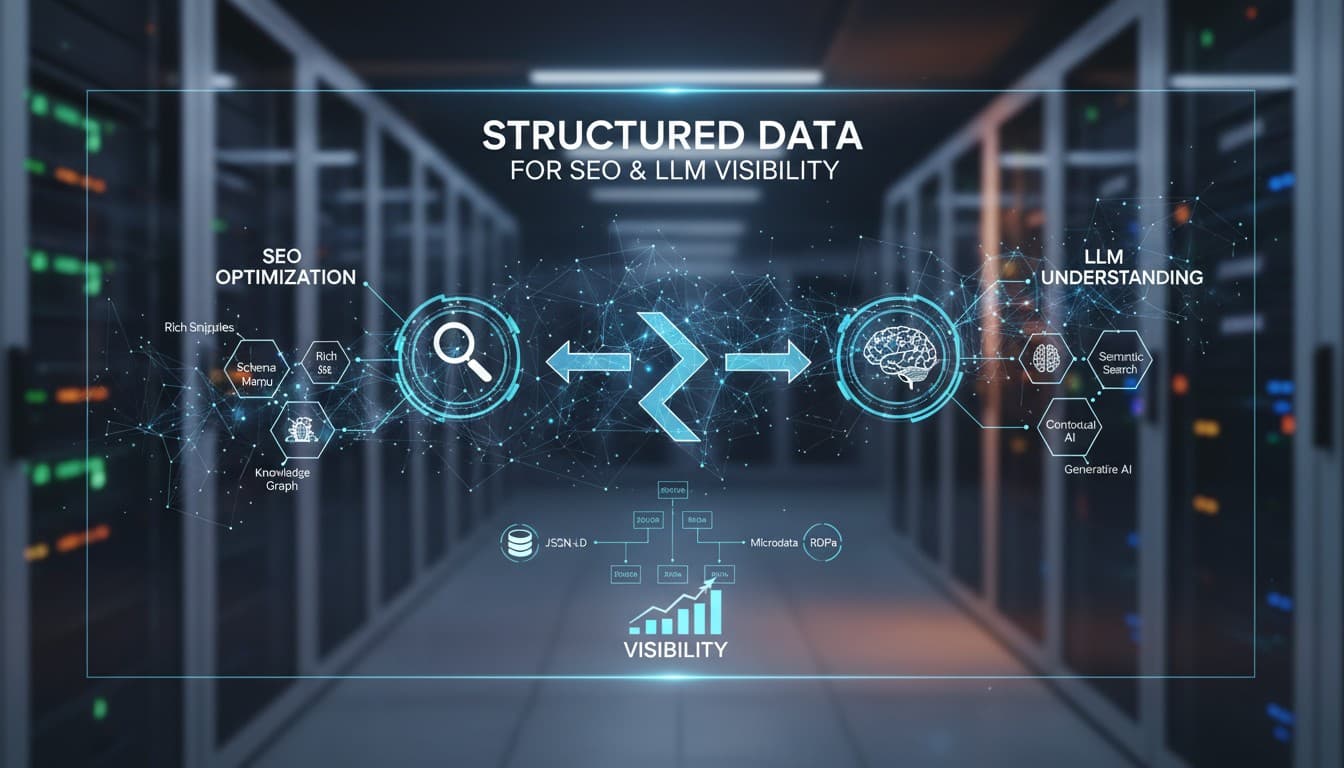
The Foundation: Understanding Structured Data and Its Purpose
Think of your website's content like a book. When you read a book, you easily understand what the title is, who the author is, and where the story begins. But computers, especially search engines and AI, don't read in the same way. They need a little help to understand your content deeply.
This is where structured data comes in. It's a special way to organize information on your web pages so that machines can easily understand it. Imagine you have a recipe on your website. Structured data lets you label parts of that recipe clearly: "This is the name of the dish," "These are the ingredients," "This is the cooking time," and "This is the star rating."
Why Structured Data Matters
The main purpose of structured data is to give context. Without it, a search engine might see the number "5" on your page. Is it a product quantity? A rating? A house number? Structured data removes the guesswork. It tells the machine, "This '5' is a star rating for a chicken recipe."
This clear labeling has big benefits for both traditional search engine optimization (SEO) and how AI systems understand your brand.
Helping Traditional Search Engines
For regular search engines like Google, structured data helps in a few key ways:
- Rich Results: This is often the most visible benefit. Structured data allows your website to show up in search results with extra features. Think of star ratings under a product, event dates, or even how-to steps directly in the search page. These "rich results" make your listing stand out and can lead to more clicks.
- Better Understanding: It helps search engines grasp the main topic of your page more accurately. When a search engine fully understands what your content is about, it can match your page with more relevant searches.
Boosting Visibility with AI and LLMs
The rise of Large Language Models (LLMs) like ChatGPT and Gemini has made structured data even more important. These AI systems don't just find links; they answer questions. To give good answers, they need to understand facts, relationships, and context from the vast amount of information online.
- Entity Understanding: AI uses structured data to quickly learn key facts about people, products, places, or concepts (called entities) mentioned on your site. When your data is well-structured, the AI can more confidently use your information.
- Accurate AI Answers: When an LLM generates a response to a user's question, it aims to provide accurate information. If your website has clear, structured data, it's easier for the LLM to identify your content as a reliable source. This increases the chance that your brand or website will be mentioned or cited by the AI. You can learn more about how AI uses information to generate answers in our article on mentions.
- Improved AI Visibility: Properly implemented structured data directly impacts your brand's "AI Visibility." This refers to how often and how accurately AI platforms understand and recommend your brand. Essentially, structured data acts as a guide, making it simpler for AI to find, interpret, and present your information correctly to users. Discover more about improving your brand's presence with AI in our guide to AI Visibility.
In short, structured data is like giving your website a clear, machine-readable identity card. It helps both traditional search engines and advanced AI systems understand your content better. This makes your information more accessible and useful across the entire digital world. For a deeper dive into the common vocabulary used, you can explore the official Schema.org website.
The Foundation: Understanding Structured Data and Its Purpose
Structured data organizes information on your website so computers can understand it better. Think of it like a clear, labeled recipe. Without it, machines guess what your content means. With it, they get exact details.
Understanding Data Types
Data exists in various forms:
- Structured Data: This is highly organized, like a spreadsheet. It uses clear labels and specific patterns, making it easy for machines to read (for example, customer details in a database).
- Semi-Structured Data: This has some organization but is more flexible. It uses tags to group information (for example, JSON or XML files). It balances flexibility with being somewhat machine-readable.
- Unstructured Data: This has no fixed organization. It is the most common type online (for example, a blog post, image, or video). Humans understand it easily, but computers struggle without extra help.
Why Search Engines and AI Need Structured Data
Search engines (Google, Bing) and AI models (like ChatGPT, Gemini) are smart, but they do not "understand" content like humans. They need clear clues.
For example, on a movie review page, a human knows the title, director, and rating. A machine just sees words. Structured data tells the machine, "This text is the movie title," "This number is the rating," and "This name is the director."
This clear labeling helps search engines:
- Show Rich Results: Like star ratings or prices in search results, making your listing stand out.
- Improve Relevance: Better matching your content to user searches.
- Build Knowledge Graphs: Creating vast networks of facts.
For AI models, structured data is vital. They learn from huge text amounts, but for specific questions, structured data offers reliable facts. It helps prevent "hallucinations" (making things up) by giving clear data points. This also helps AI understand if your brand is mentioned positively or negatively, which MeasureLLM's tools track for brand visibility.
The Role of Context and Meaning
Machines do not infer context; they need it spelled out. Structured data defines relationships, providing this meaning. It tells a machine, "Actor X starred in Movie Y," or "Product Z costs $100." This creates a clear picture. Without this, AI models might misinterpret information, leading to poor search results or wrong AI answers. Structured data ensures your website's true meaning is understood.
A Brief History of Structured Data on the Web
The internet began with mostly unstructured text. As websites grew, search engines struggled to understand the huge amount of information. They needed better ways to sort and show content.
In 2011, Google, Bing, Yahoo!, and Yandex created Schema.org. This gave websites a common "vocabulary" to describe things. Before this, sites used different terms. Schema.org offered one agreed-upon set of terms, easing how search engines processed web data. Today, using Schema.org is standard for boosting web visibility and helping AI.
This shift impacts how your brand appears in traditional search and AI answers. Find more tips on winning AI mentions in our blog.
The Universal Language: Mastering Schema.org Vocabulary
Imagine the internet as a huge library. Without a good catalog system, finding what you need is tough. Structured data acts like that catalog, and Schema.org is the universal language everyone agrees to use for it.
Schema.org is not just one company's idea. It is a shared project. Big search companies like Google, Microsoft, Yahoo, and Yandex all work together on it. Their goal is to create a common set of words (vocabulary) that describes things on the internet. This helps machines understand your content better. You can think of it as teaching search engines and AI to speak your website's language.
A Look at Schema's Dictionary: Types and Properties
The Schema.org vocabulary is vast. It works like a dictionary for the web. It has:
- Types: These are like nouns. They describe what something is. For example,
Organization,Person,Article,Product,Recipe,Event, orLocalBusiness. Each type has its own meaning. - Properties: These are like adjectives or verbs. They describe the details or features of a type. For example, a
Producttype might have properties likename,description,price, andbrand. AnArticletype could haveheadline,author, anddatePublished.
Let's look at some common types and their properties:
- Organization: This type describes a company or group. You can add properties like
name,logo,url, andcontactPoint. - Person: This describes an individual. Useful properties include
name,jobTitle, andalumniOf(for their education). - Article: Perfect for blog posts or news. Key properties are
headline,author,datePublished, andimage. - Product: For items you sell. Include
name,description,image,offers(which includesprice), andaggregateRating. - Recipe: For food blogs. Properties like
name,ingredients,prepTime, andrecipeInstructionsare important. - Event: For concerts, webinars, or workshops. Use
name,startDate,location, andperformer. - LocalBusiness: For brick-and-mortar stores. This type can have
name,address,telephone, andopeningHours.
You apply these properties to their specific types. You would not use a price property for a Person type, for instance. It only makes sense for a Product or Service.
Connecting the Dots: Nested Schema
Sometimes, information is not stand-alone. It is connected. This is where nested schema comes in. Nested schema means you can embed one type of schema inside another. It helps you build complex, interconnected data models.
For example, an Article might have an author property. The value for that author property could be a Person type, which then has its own name, jobTitle, and url properties. This way, search engines and AI understand that the article was written by a specific person, not just a name. It creates a richer, more complete picture of your content.
Understanding and using this common vocabulary is a powerful way to make your website more understandable to machines. When search engines and AI platforms fully grasp your content, it boosts your online visibility. Tools like MeasureLLM can track how often AI mentions your brand after you implement structured data, helping you see the impact on your brand's presence in AI search. You can learn more about how to win AI mentions for your brand by exploring our blog (https://www.measurellm.com/blog/generative-engine-optimization-geo-how-to-win-ai-mentions-for-your-brand).
For a complete list and details on all the available types and properties, you can always refer to the official Schema.org website (https://schema.org).
Speaking to Machines: Choosing and Implementing Structured Data Formats
When you decide to speak to machines, you need to pick the right language. Structured data has a few dialects. The main ones are JSON-LD, Microdata, and RDFa. Each has its own way of adding meaning to your web content.
JSON-LD: The Modern Choice
JSON-LD (JavaScript Object Notation for Linked Data) is the most popular and flexible way to add structured data. Think of it as a small block of code that sits in the <head> or <body> section of your web page. It's separate from the visible content. This makes it clean and easy to manage.
Why JSON-LD is often best:
- Cleaner Code: It keeps your main HTML code tidy because the structured data lives in its own script block.
- Easier to Implement: You can add it without heavily changing your existing HTML.
- Dynamic Injection: You can easily add or change JSON-LD using JavaScript, which is helpful for websites built with dynamic content.
Practical JSON-LD Examples:
Imagine you have a recipe page. You could use JSON-LD to tell search engines about the ingredients, cooking time, and reviews. For a blog post, you might use the "Article" schema type. If you have a list of common questions and answers, the "FAQPage" schema is perfect. And for step-by-step guides, "HowTo" helps explain each step clearly. Google and other search engines strongly recommend JSON-LD for most uses.
Here's a simple example of how JSON-LD for an Article might look (briefly, not full code):
<script type="application/ld+json">
{
  "@context": "https://schema.org",
  "@type": "Article",
  "headline": "My Great Blog Post",
  "author": {
    "@type": "Person",
    "name": "Jane Doe"
  },
  "datePublished": "2023-10-26"
}
</script>
(Note: This is just a simple example to show the concept, not a complete implementation.)
Microdata: Embedding in HTML
Microdata is an older method. It works by adding special attributes directly into your HTML tags. So, if you have a product name in a <span> tag, you'd add Microdata attributes right to that <span>.
When to use (or avoid) Microdata:
Microdata can be useful for older websites or when you only need to mark up small parts of text. However, it can make your HTML code look cluttered. It can also be harder to update or change compared to JSON-LD. For new projects, JSON-LD is usually the better choice.
RDFa: A Less Common Option
RDFa (Resource Description Framework in Attributes) is another way to embed structured data directly into HTML. Like Microdata, it uses attributes within your existing HTML tags. It's less common than JSON-LD or Microdata, but it is still a valid option. You might see it on older sites or in specific industry applications.
Comparing the Formats: Making Your Choice
For most websites and new projects, JSON-LD is the top recommendation. It offers the best balance of flexibility, ease of use, and clean code. It's also what major search engines prefer.
If you have an existing site with Microdata, you might keep it. But for adding new structured data, switching to JSON-LD is a smart move. You can always learn more about all the possible schema types on the official Schema.org website.
Choosing the right format is the first step in making sure your content is understood by machines. This understanding is key for both traditional SEO and for how Large Language Models like ChatGPT process your information. For more technical guides on getting started, you can also check out the resources available on the MeasureLLM blog.
Beyond SEO: Structured Data for AI and Large Language Model (LLM) Visibility
Structured data isn't just for Google Search anymore. It's becoming vital for how Large Language Models (LLMs) like ChatGPT and Gemini understand and use information. Think of it as teaching AI about your business. When you use structured data, you speak the language these powerful models can best understand.
Better AI Understanding and Entity Recognition
LLMs are built to process and generate human-like text. But they need clear facts to do this well. Structured data gives them those facts in an organized way. For example, if you sell a specific product, Product schema tells an LLM its exact name, brand, price, and features. This helps the AI recognize your product as a distinct "entity" (a real-world thing, person, or concept).
When LLMs clearly understand your products, services, or brand, they are less likely to get things wrong. This leads to more accurate answers when users ask questions about your company. It also helps them connect your brand to related topics, building a richer picture of who you are.
Increasing AI Mentions and Recommendations
When an LLM provides an answer, it often pulls information from various sources. Structured data makes your content a prime candidate for these sources. If your data is well-organized and easy for the AI to parse, it becomes more likely to be mentioned or recommended in AI responses.
Imagine someone asks an LLM, "What's a good recipe for apple pie?" If your recipe website uses Recipe schema, the LLM can quickly find and understand the ingredients, steps, and cooking time. This clarity boosts your chances of being suggested. Tools like MeasureLLM can help you track where and how often AI platforms mention your brand (see our guide on Generative Engine Optimization (GEO)).
Improving Answer Quality and Reducing AI "Hallucinations"
One big challenge with LLMs is "hallucinations." This is when they make up facts or give incorrect information. Structured data acts as a guardrail against this. By providing clear, factual details, you give the LLM reliable information. This helps it generate more accurate and trustworthy answers.
For example, if an AI is asked about your business hours, having them clearly marked with LocalBusiness schema means the AI can pull the correct times. It won't have to guess or infer from unstructured text. This directness improves the quality of the AI's response and builds trust in the information it provides about your brand.
Building Your Brand's "Visibility Score" with AI
Just as SEO aims for high rankings in traditional search, Generative Engine Optimization (GEO) aims for strong visibility within AI responses. Structured data is a core part of your GEO strategy. It helps you control the narrative an AI tells about your brand. By using schemas from Schema.org, you provide a common language for both search engines and LLMs.
Monitoring your brand's presence in AI answers can be crucial. Services like MeasureLLM track your brand's Visibility Score across different AI platforms. This helps you understand how well LLMs are recognizing and using your structured data. It shows you if your efforts are making your brand more prominent and accurately represented in AI-generated content.
Beyond SEO: Structured Data for AI and Large Language Model (LLM) Visibility
Structured data has been a secret weapon for SEO for years. It helps search engines like Google understand your content better. But today, its importance goes far beyond getting your website to rank higher. Structured data is now key for how Large Language Models (LLMs) and other AI systems see and use your brand's information.
Bridging the Semantic Gap for AI
Think about how humans talk. We use words, but we also understand context and unspoken meanings. Machines, especially AI, need things spelled out clearly. This is where structured data steps in. It takes your human-readable content and translates it into facts that machines can easily understand.
For example, when you write "The event is on October 26th," an AI might understand it as text. But with structured data, you can tag "October 26th" as a startDate property for an Event schema. This gives the AI explicit, machine-readable facts. It fills the "semantic gap," making sure the AI knows exactly what your content is about.
Enhancing LLM Comprehension and Accuracy
AI models, like ChatGPT or Gemini, learn from vast amounts of data. But even with all that data, they can sometimes misunderstand or even "make things up" (called hallucinations). Structured data helps make AI smarter and more reliable.
- Clearer Context: Structured data gives AI models clear context and shows the relationships between different pieces of information. For instance, it can tell an AI that a certain address is the
locationof aLocalBusiness. This reduces guesswork. - Fewer Hallucinations: When an LLM has access to solid, verified facts through structured data, it is much less likely to invent information. Your structured content provides authoritative data points, which can act as guardrails for the AI.
- Better AI Output: This leads to more precise summaries, accurate answers to questions, and better content generated by AI based on your original sources.
Feeding Knowledge Graphs for AI Systems
Many advanced AI systems, especially those used by large companies, rely on "knowledge graphs." These are like giant, interconnected maps of facts. Structured data is a main way to build and feed these knowledge graphs.
Your structured content becomes a primary input for these AI knowledge bases. This includes systems that use Retrieval Augmented Generation (RAG), which helps LLMs get up-to-date, factual information. Structured data also plays a big role in specialized AI applications that work with specific industries or types of data.
Preparing for the Future of Generative AI Search
Search is changing. Instead of just showing lists of "blue links," AI-driven search results are moving towards giving direct, conversational answers. This means your content needs to be seen as a trustworthy source by AI.
Trusted, structured data helps establish your content's authority in this new AI-first world. It positions your brand as a credible source for AI-generated direct answers. Tools like MeasureLLM can help you track how effectively LLMs are using your structured data. It shows you if your brand is being mentioned correctly and if AI models understand your factual information, helping you improve your Visibility Score. Understanding this shift is vital for what many call Generative Engine Optimization (GEO). You can learn more about how this differs from traditional SEO at https://www.measurellm.com/blog/traditional-seo-vs-generative-engine-optimization-geo-key-differences-strategies-and-examples. This ensures your content is ready for the future of search, as discussed by experts in the field of artificial intelligence (for example, see https://www.ibm.com/ for more on AI technologies).
Implementing Structured Data: A Step-by-Step Practical Guide
Adding structured data to your website might sound complex. But there are many ways to do it, from writing code yourself to using simple tools. Here is how you can get it done.
Manual Implementation (The Developer's Way)
For those who like to get hands-on, you can write JSON-LD code directly. JSON-LD (JavaScript Object Notation for Linked Data) is the preferred format for most search engines. It's like writing a small script that describes your page's content.
You typically place this code within a <script type="application/ld+json"> tag. It's best to embed this code in the <head> section of your HTML document. This way, search engines see it early when they visit your page. You can also place it in the <body>, especially for content that loads later. But the <head> is usually the top choice.
Using Structured Data Markup Generators
Not everyone is comfortable writing code from scratch. That is okay. Many tools can help you create structured data.
- Google's Structured Data Markup Helper: This free tool lets you highlight parts of your web page to create the JSON-LD code.
- Schema App: A more advanced tool for creating and managing schema markup.
- Merkle Schema Generator: This tool helps you create common schema types quickly.
Let's say you have a recipe page. You could use a generator to pick the "Recipe" schema type. Then you would fill in details like ingredients, cooking time, and reviews. The tool creates the code. You then copy and paste this code into your website's HTML. This makes it much simpler to use different schema types, like Product for e-commerce or Article for blog posts.
WordPress Plugins for Simplified Implementation
If your website uses WordPress, plugins offer an easy path. They manage much of the technical work for you.
- Yoast SEO: This popular plugin includes basic structured data features for posts and pages.
- Rank Math: Another powerful SEO plugin that offers detailed schema markup options.
- Schema Pro: A dedicated plugin for more advanced and automated schema markup.
Plugins are great for ease of use. They often automate schema for common content types, saving you time. However, they might not offer as much control as manual coding for very specific needs. You weigh simplicity against complete customization.
Implementing via Google Tag Manager (GTM)
Google Tag Manager (GTM) helps you add and update website tags without changing your site's code directly. You can use it to inject JSON-LD structured data.
You would create a "Custom HTML" tag in GTM. Then, paste your JSON-LD code into it. Set this tag to fire on the pages where you want the structured data to appear. GTM is very useful for dynamic content. It helps when you do not have direct access to your website's code or when you need to quickly add or change schema across many pages. This method is often chosen for larger sites or those with frequent content updates.
Content Management Systems (CMS) with Built-in Structured Data Support
Modern Content Management Systems (CMS) often include structured data features. Platforms like Shopify, Squarespace, or even enterprise-level CMS solutions have built-in options. They might automatically add Product schema for e-commerce listings or Article schema for blog posts. Leveraging these features saves development time and helps ensure basic structured data is present.
Handling Dynamic Content and APIs
Some websites have content that changes often or is pulled from databases. Think of e-commerce sites with thousands of products, user-generated reviews, or large data sets. For these, you need smarter strategies.
You might use APIs (Application Programming Interfaces) to automatically generate and inject structured data. This ensures your schema stays current, even when product prices change or new reviews appear. This is critical for keeping search engines and LLMs informed with the freshest data. To track how AI platforms respond to these updates, tools like MeasureLLM can help by showing you shifts in your brand's AI Visibility Score. You can learn more about how we track these insights on our About Us page.
For more technical details on using schema, visit the official Schema.org website.
This is a critical step. You need to make sure your structured data is correct and actually working. It is not enough to just add it. You must check it regularly. This helps search engines and large language models (LLMs) understand your content without confusion.
Google Rich Results Test
This free tool from Google is a must-use. It shows you if your web page is eligible for rich results. Rich results are special listings, like star ratings or product prices, that appear right in search results. Just paste your URL or code snippet. The test will highlight any critical errors that stop rich results from showing. It also gives warnings for things that could be improved.
You will see what properties are required for a certain rich result type to work. It also points out recommended properties, which can make your rich result even better. Understanding these results helps you fix problems quickly and get the most out of your structured data.
Schema Markup Validator (Schema.org Tool)
Beyond Google's specific rich results, you want to make sure your structured data follows the general rules set by Schema.org. The Schema Markup Validator, run by Schema.org, checks the syntax of your code. This means it looks at whether your code is written correctly. It also ensures you are using the right vocabulary from Schema.org.
This step is key for universal understanding. It is important not just for Google, but for any system trying to read your data. This includes large language models. A valid schema ensures clarity for all.
Google Search Console (GSC)
Google Search Console is your long-term monitoring hub. It gives you a broad view of how Google sees your rich results across your entire website. You can find reports under "Enhancements" that show you if there are site-wide errors. GSC lets you track how your fixes are improving things over time. It also shows you performance reports, so you can see if your rich results are getting more clicks or impressions. This helps you understand the direct SEO impact.
While GSC focuses on Google's search results, you will also want to know how this data affects your visibility in AI tools. Keeping an eye on these broader trends can help you see if your structured data is boosting your brand mentions and sentiment with LLMs. For instance, MeasureLLM offers tools to help you set up alerts for any significant shifts in how AI models talk about your brand.
Browser Extensions and Other Tools
For quick checks during development, browser extensions are very handy. Tools like "Schema Builder" or "Structured Data Testing Tool" add-ons let you inspect structured data right on a live page. They can help you quickly debug small issues without needing to go to external websites. Think of them as your daily mini-check-up tools. They are great for spotting problems fast as you build or update pages.
Common Structured Data Pitfalls and How to Avoid Them
Even with the best intentions, it's easy to make mistakes when working with structured data. These errors can stop search engines and AI models from understanding your content. This section covers common problems and offers simple ways to avoid them.
Incorrect or Incomplete Implementation
The Pitfall: This happens when you miss important pieces of information in your structured data. Or, you might use the wrong type of data for what you are describing. For example, marking a product's name as its price.
How to Avoid It: Always double-check that you have included all required properties for your chosen schema type. Use tools like Google's Rich Results Test to make sure your data is complete and correctly formatted.
Content Mismatch
The Pitfall: Marking up information that isn't actually visible to users on your web page. Or, worse, misrepresenting the content. For example, showing one price in schema but a different, higher price on the page.
How to Avoid It: Only mark up content that users can clearly see and read on your page. The structured data should always match the visible content exactly. Be honest and transparent.
Spammy Markup
The Pitfall: Trying to trick search engines by hiding content in schema, stuffing keywords, or marking up data that has nothing to do with the page.
How to Avoid It: Keep your structured data clean and useful. Only mark up the main, relevant content of your page. Do not use schema to hide text or add keywords that aren't truly part of your page's content.
Outdated Information
The Pitfall: Your structured data stays the same even when the content on your page changes. This could be old prices, event dates, or product availability.
How to Avoid It: Set up a routine to update your structured data whenever you change the actual content on your page. Regularly check and update your structured data. This helps make sure AI models have the freshest information about your brand, which can impact your brand's overall visibility score.
Ignoring Google's Structured Data Guidelines
The Pitfall: Not following the specific rules and recommendations from search engines like Google for how to use structured data.
How to Avoid It: Always read and follow the official rules set by search engines like Google. You can find their guidelines on their developer site. These guidelines cover both technical details and quality standards.
Lack of Testing and Validation
The Pitfall: You implement structured data but don't check if it's working correctly or if it has errors, especially after site updates.
How to Avoid It: Always test your structured data with tools like Google's Rich Results Test. Make it part of your routine when you're getting started with new content or making big site updates. This helps you catch problems before they affect your search presence.
Over-optimization and Redundancy
The Pitfall: Marking up the same piece of information multiple times using different schema properties or formats on the same page.
How to Avoid It: Aim for simplicity and clarity. One clear, correct markup for a piece of information is usually enough. Avoid unnecessary repetition, which can confuse search engines.
Security Concerns
The Pitfall: Injecting JSON-LD code from untrusted or unverified sources, which could contain malicious code.
How to Avoid It: Only use structured data code that you or a trusted developer create. Be very careful about copying and pasting code snippets from unknown websites without fully understanding what they do.
Advanced Strategies and Best Practices for Maximizing Impact
Getting structured data basics right is a good start. To truly stand out, use advanced tactics. These tips help your content speak even more clearly to search engines and large language models (LLMs).
Connect Your Brand with sameAs
The sameAs property links different web mentions of the same thing. Use it in your schema to connect to sources like social media, Wikipedia, or Wikidata. This tells search engines and LLMs these pages refer to your brand, building identity. This can boost your Brand Mentions in LLM answers.
Build Richer Connections with Nested Schema
One piece of structured data isn't always enough. Nested schema links different types together. For an event, use Event schema. Nest Place for the venue, and Organization for the organizer. This creates a detailed map, helping LLMs understand complex topics for better answers and recommendations.
Use Structured Data for Special Content Types
Beyond common Article or Product types, Schema.org offers many specific ones. Using these makes your content eligible for rich results. Examples: HowTo guides, VideoObject details, Course offerings, JobPosting links. These types tell LLMs what content it is, improving visibility and specific query use.
Enhance Internal Linking with Semantic Connections
Semantic interlinking uses structured data to show relationships between entities on your site. Link the meaning behind text, not just pages. This helps search engines and LLMs understand deeper connections, strengthening your website's authority on topics.
Embrace Linked Data Principles
Linked Data creates a web of interconnected information using unique identifiers. By making your structured data part of this larger web, you help machines understand and connect information across the internet. This makes your content more discoverable and globally understandable.
Plan Structured Data with Your Content Strategy
Make structured data a core part of content planning. When creating new content, think about applicable schema types from the beginning. This ensures all relevant information is captured, accurate, and complete. This saves time and makes content more effective.
Stay Updated with Schema.org and Search Engine Changes
The world of structured data and AI is always changing. Schema.org updates regularly. Search engines also change their guidelines. Keep an eye on updates from Schema.org (https://schema.org/) and resources like the Google Search Central blog. Staying current keeps your structured data effective.
Measuring the ROI of Your Structured Data Efforts
After adding structured data, you need to know if it's paying off. Measuring the Return on Investment (ROI) means checking if your efforts bring good results and value. This helps you see what works and where to improve. Here's how to track your structured data's success.
Google Search Console Performance Reports
Google Search Console (GSC) is a free Google tool that shows how your website performs in search. In the "Performance" report, you can see details about your rich results, including:
- Impressions: How many times your rich result appeared.
- Clicks: How many times people clicked your rich result.
- Click-Through Rate (CTR): The percentage of people who saw and clicked your rich result.
More impressions and clicks on rich results often mean your structured data helps your content stand out. You can learn more about how Google uses structured data on their official developer site (https://developers.google.com/).
A/B Testing Your Structured Data
A/B testing compares two versions of something to see which works better. For structured data, you can:
- Choose similar pages on your site.
- Add structured data to some pages (Version A).
- Leave other similar pages without structured data (Version B).
- Track their performance over time.
Look for differences in search visibility, traffic, and user engagement. This confirms if structured data impacts those pages positively.
Using Analytics Platforms
Analytics tools (like Google Analytics) help you understand website usage. When traffic comes from rich results, you can check its quality. Look at metrics such as:
- Bounce Rate: How many people leave your site right away. A lower bounce rate from rich results suggests better-matched visitors.
- Pages Per Session: How many pages people view after clicking a rich result.
- Conversion Rates: If visitors from rich results complete a goal, like buying something or signing up.
Good quality traffic from rich results means visitors found what they needed.
SERP Tracking Tools
SERP (Search Engine Results Page) tracking tools show how your content appears in search results. These tools can:
- Show if your rich snippets appear for your target keywords.
- Track changes in your rich snippet presence over time.
- Let you see if your competitors use rich snippets and how often.
Monitoring trends helps you react quickly, keeping your structured data effective.
Qualitative AI Feedback
Structured data helps search engines and Large Language Models (LLMs) understand your content. But how do you know if AI truly understands your brand? This is where qualitative AI feedback comes in.
You can assess if better structured data leads to:
- Better AI Comprehension: Does AI accurately summarize your products or services?
- More Accurate LLM Outputs: When people ask AI about your brand, is the information correct?
- Improved User Experiences: Are AI answers based on your content clear and useful?
Tools like MeasureLLM can help you track your brand's presence and how it's understood by various AI platforms (learn more about ChatGPT and Gemini). By monitoring brand mentions and sentiment shifts from AI answers, you can see if your structured data makes your content clearer to LLMs. This ensures your brand is represented accurately when AI talks about you.
Your Future-Proof Strategy for SEO and AI Dominance
You have learned that structured data holds immense power for your digital presence. It works on two major fronts. First, it makes your website clear to traditional search engines, helping you rank higher. Second, it helps new AI platforms, like ChatGPT or Gemini, understand your brand better. This means your brand is more likely to be mentioned and recommended by AI. Think of structured data as giving both search engines and AI a precise map to your content. This helps your information truly stand out.
Investing in structured data is not just a passing trend. It is a fundamental part of any smart digital marketing plan today. It ensures search engines quickly grasp the core topic of your web pages. This directly affects how well your brand appears in search results. For AI, structured data helps build a strong, clear picture of your company. This can boost your brand's "Visibility Score" in AI answers. It also helps make sure AI platforms talk about your brand accurately and in a good light. You are actively shaping how these powerful new tools perceive your business.
The world of search and artificial intelligence is always changing. What works effectively today might need adjustments tomorrow. Because of this constant change, staying updated on structured data best practices is vital. Search engines, such as Google, often refine their guidelines. AI models also continue to learn and evolve. Keeping your structured data current means your brand stays relevant and easy to find for both people and machines. Staying informed by reliable sources, like Google Developers (https://developers.google.com/), can help you adapt quickly to new developments.
Now is the perfect time to take action. Start putting structured data into practice on your website. Regularly test your implementation to confirm it is working correctly. Always look for ways to improve it. This will unlock its full potential for your SEO and how AI sees your brand. Tools can help you track your progress. For example, MeasureLLM can show you how AI platforms mention your brand and understand the general feeling around those mentions. It helps you measure your competitive share of voice, revealing if AI recommends you over others. By doing this, you are not just hoping for visibility. You are actively building and securing it. Make structured data a priority. It is how you build a future-proof digital strategy.