
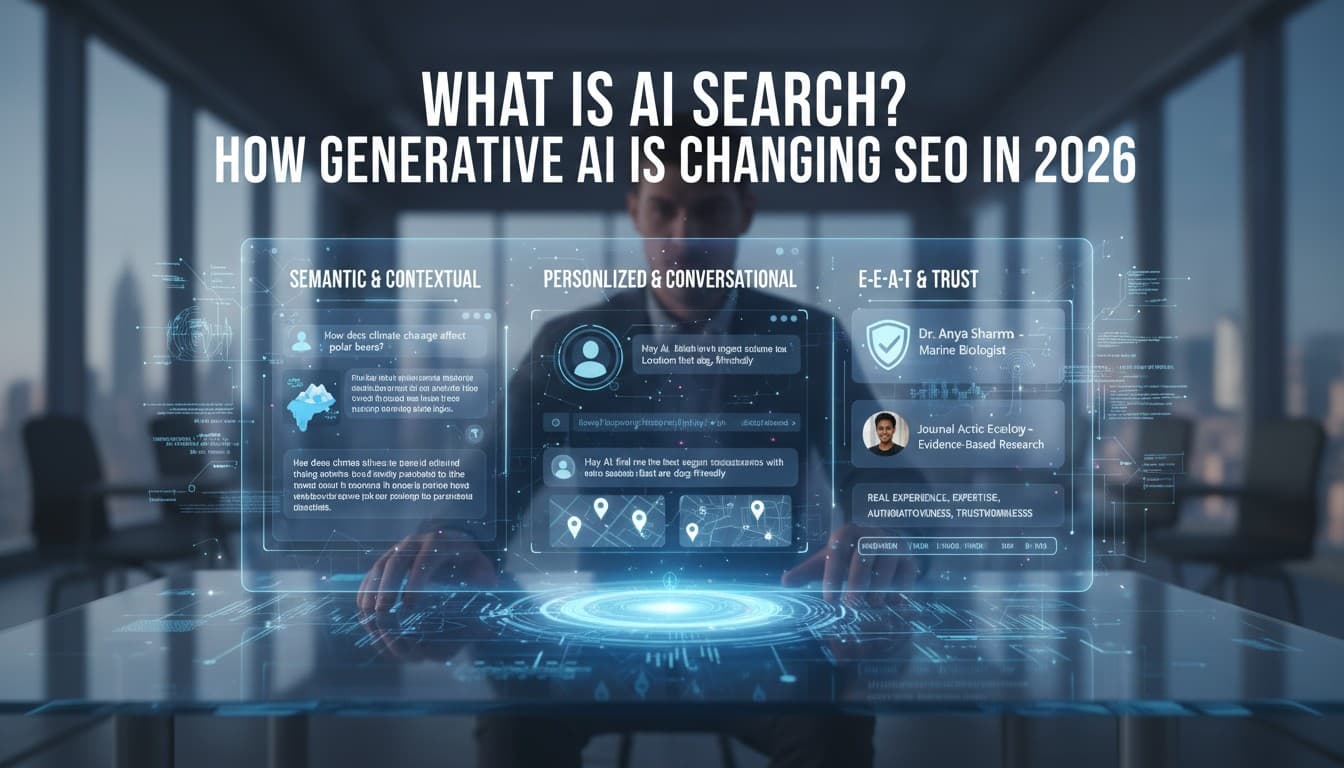
What Exactly is AI Search? A New Era of Information Retrieval
AI search is a new way to find information online. It uses artificial intelligence to understand what you mean, not just the exact words you type. Think of it like talking to a very smart helper who gives you a direct answer, instead of just a list of links to click through.
With old search engines, you typed keywords into a search bar. The engine then matched those words to relevant web pages and gave you a list of links. You had to click through them, sometimes many, to find the exact answer you needed. AI search is different. It tries to understand your full question and what you truly intend to find, similar to how a person would. It then uses its advanced understanding to create a comprehensive answer for you. This means you might get a summary, a specific paragraph, or even a step-by-step guide, delivered right on the search results page, saving you time.
The technology behind this change often involves Large Language Models (LLMs). These are advanced AI programs that have learned from huge amounts of text and data. They can generate human-like text, summarize information, and even answer complex questions. Companies like OpenAI (https://openai.com/) develop some of these powerful models.
This shift deeply changes how people get information. Instead of browsing through many websites, users receive quick, summarized answers directly. This can be very helpful for complex topics, like understanding a medical condition, or when you simply need a fast fact, such as the capital of a country. For example, if you ask "What are the benefits of eating blueberries?", an AI search engine might give you a direct list of health benefits and nutritional facts, often pulled from several reliable sources and presented clearly.
For businesses and brands, this new search method changes how people find them. Your brand might appear directly in an AI-generated answer, mentioned as a recommended product, service, or expert. This is different from just ranking high in a list of web links. To stay relevant, you need to know how your brand shows up in these summarized answers. Tools like MeasureLLM help you track your brand's presence, including your AI Visibility Score and specific brand mentions. Learning how to get your brand recognized in these new results is part of a strategy often called Generative Engine Optimization (GEO). You can explore how to win these mentions in our detailed guide on Generative Engine Optimization.
What Exactly is AI Search? A New Era of Information Retrieval
Think about how you've used search engines for years. You type keywords, hit enter, and get a long list of blue links. Your job was then to click through those links to find your answer. Traditional search was good at matching keywords. But it often didn't truly understand what you were asking.
AI search changes this game completely. It's a powerful way to find information that uses artificial intelligence. Instead of just matching words, AI search tries to grasp the full meaning, context, and tiny details of your question. This means it understands your intent, even if your keywords are not perfect.
Imagine asking a question like, "What's the best way to train a new puppy for housebreaking?" Old search might show you articles with "puppy," "train," and "housebreaking" in them. AI search, however, uses its intelligence to summarize common methods, offer direct advice, and even suggest tools. It gives you a direct, relevant answer right away.
The main difference is clarity and directness. AI search uses smart algorithms to deliver answers that are more:
- Relevant: It digs deeper than keywords to understand your actual need.
- Personalized: Over time, it can learn your preferences and tailor results just for you.
- Direct: Often, you get a summarized answer or a step-by-step guide instead of a list of websites.
This is a big step beyond the old way. It's like moving from a giant library catalog to a knowledgeable librarian who can answer your specific questions on the spot. AI search looks at the whole picture, pulling together facts and ideas from many sources to give you a concise response. This ability to understand and summarize means that how your brand is presented in these summaries (often called "mentions") becomes incredibly important. Tools like MeasureLLM can help you track these brand mentions in AI search results.
This approach offers clear benefits. Users save time because they don't have to sift through pages of links. The answers are often more accurate because AI can cross-reference information from many places. This makes finding information much faster and more satisfying. As AI technologies continue to improve, this shift will only become more common. For more on the bigger picture of AI's impact on technology, you can explore resources like Wired.com.
How AI Search Works: The Technology Under the Hood
AI search is much more than just matching keywords. It uses advanced computer science to understand what you mean, not just what you type. Here is a look at the core parts that make it all work.
Understanding Your Language
At its heart, AI search uses two key technologies:
- Natural Language Processing (NLP): This helps the computer understand human language. It's how the AI figures out the meaning behind your words, phrases, and even entire questions. Think of it like the AI "listening" to what you are really asking.
- Machine Learning (ML): This allows the AI to learn from huge amounts of data. Over time, ML helps the system get better at finding patterns, making predictions, and giving you more accurate answers.
Finding Meaning, Not Just Words
Unlike old search engines, AI search dives deeper into meaning:
- Semantic Understanding and Vector Search: The AI doesn't just look for exact words. It tries to understand the full meaning (semantics) of your search. To do this, it turns your question and all the information it knows into special numerical representations, called "vectors." Then, it finds other information with similar vectors, meaning they have similar meanings. This process is called "vector search."
- Knowledge Graphs: Imagine a giant map of facts and how they connect. This is a knowledge graph. For example, the AI knows "Paris" is a "city," "France" is a "country," and "Paris" is the "capital of" "France." These connections help the AI build a rich understanding of different topics. You can learn more about how AI uses these connections in our post about ChatGPT entities and AI knowledge panels for SEO.
Creating Smart Answers
The newest part of AI search comes from its ability to create new information:
- Generative AI and Large Language Models (LLMs): These systems (like those behind ChatGPT) can generate new text, summaries, or even conversational answers. They do not just pull up existing pages. They can write fresh, coherent responses based on their training. A lot of this research is pushed forward by organizations like OpenAI (https://openai.com/).
- Retrieval Augmented Generation (RAG): Sometimes, AI models can make up facts. To prevent this, AI search uses RAG. This means the AI first finds factual information from reliable sources (retrieval). Then, it uses that verified information to create its answer (generation). This helps ensure the answers are correct and based on real data.
Tailored for You
Finally, AI search aims to give you the most relevant information possible:
- Personalization: The system can tailor results based on who you are. It might consider your past searches, your current location, or what it thinks your true goal is. This helps make the answers more useful and specific to your needs.
You can see these technologies in action with tools like Google's Search Generative Experience (SGE) and Microsoft Copilot (which was formerly known as Bing Chat). These platforms are changing how we interact with information every day.
The Transformative Impact of AI Search on SEO
AI search is changing how we find information online. For businesses and content creators, this means big shifts in how search engine optimization (SEO) works. It's not just about traditional ranking signals anymore.
How Search Results Look Now
When you use an AI search engine, the results page often looks very different. Instead of just a list of links, you'll see:
- Generative Answers: These are AI-written summaries at the top, giving you a direct answer without needing to click a link.
- Rich Snippets and Direct Answer Boxes: These show quick facts or specific answers right on the page, like weather or a recipe.
- Conversational Interfaces: You can chat with the search engine, asking follow-up questions just like you would with a person.
This means your content might appear in a summary rather than as a clickable link.
Changing Your Content Strategy
The way you create content needs to change.
- From Keywords to Full Topics: It's no longer enough to just target a few keywords. AI wants to see that you are an expert on an entire topic. You need to cover all related ideas and entities thoroughly.
- Fact-Checking and Depth are Key: AI values correct, deep information and unique insights. Your content must be trustworthy and offer real value. If it's just repeating what others say, it might not stand out.
- Understanding User Intent: Think about what a user really wants when they search. Is it a quick fact, a detailed guide, or a product to buy? Your content should answer all parts of their question, from general information to specific buying needs.
New Ways to Rank
Traditional ways of ranking are becoming less important.
- Beyond Simple Signals: Things like keyword density (how many times you use a keyword) matter less. Now, AI focuses on how relevant your content is to the whole topic and how authoritative it seems.
- Brand Visibility in AI Answers: Since AI often gives direct answers, people might click on fewer links. This makes it crucial for your brand to be mentioned and accurately summarized in those AI answers. You can track this kind of presence, often called a Visibility Score, to see how often AI platforms recommend your brand. (You can learn more about how to track this on our Visibility Scores page).
The Challenge of AI-Generated Content
While AI is powerful, it's not perfect.
- Quality and "Hallucinations": Sometimes AI can make mistakes or "hallucinate" (make up facts). This means human oversight is still very important to ensure the information it provides is correct and helpful. Publishers should always double-check any AI-generated content for accuracy, according to sources like Statista.
These changes mean that SEO is evolving. It requires a more thoughtful, comprehensive approach to content creation and a deeper understanding of how AI processes information.
Adapting Your SEO Strategy for the AI Search Era
The shift to AI search means that how we approach SEO must also change. It is no longer just about matching keywords. It is about deep understanding, quality, and clear communication. Here are the key ways to update your SEO strategy for this new world.
Mastering Advanced User Intent and Contextual Relevance
AI is smart. It understands what a user really means, even if their search query is vague. Your content needs to anticipate not just the direct question, but also the hidden needs and follow-up questions a user might have. Think about the full journey of a user, not just one search term.
Creating Unrivaled, High-Quality Content
In a world full of information, truly valuable content stands out. AI models are trained on vast datasets, and they favor content that is original, well-researched, and truly helpful. Avoid thin content or simply rephrasing what others have said. Aim to be the best resource available on your topic.
Structuring Content for AI Comprehension
AI needs content that is easy to understand and digest. This means using clear headings (H1, H2, H3) to organize your thoughts. Break down complex ideas into short, direct answers. Lists, bullet points, and tables are excellent for making information scannable for both humans and AI. For more on this, see our guide on structured data for LLM visibility.
Leveraging Multimedia and Diverse Formats
AI learns from more than just text. Images, videos, audio, and interactive elements can enrich user experience and help AI grasp your content's full meaning. Optimize these assets with descriptive alt text for images, clear transcripts for audio, and well-organized video content.
Optimizing for Generative Answers and Featured Snippets
AI search often provides direct answers or summaries at the top of results. These are like advanced featured snippets. To appear here, craft concise, accurate answers to common questions within your content. Make sure these answers are easy for AI to identify and pull.
Building and Demonstrating E-E-A-T (Experience, Expertise, Authoritativeness, Trustworthiness)
Google continues to stress the importance of E-E-A-T. This means proving that your content comes from a trustworthy source with real experience and expertise. Showcase author credentials, cite reputable sources, and earn backlinks from authoritative websites. Showing real-world examples and data also helps build trust. Learn more about how AI uses citations.
Embracing Semantic SEO and Entity Optimization
Move beyond simple keywords. AI understands the relationships between concepts and entities (people, places, things, ideas). Focus on creating content that connects naturally to broader topics and knowledge graphs. This helps AI understand the full context and relevance of your brand and content.
Technical SEO Remains Fundamental
Even with AI, the basic technical health of your website is crucial. Ensure your site loads quickly (Core Web Vitals), works well on mobile devices, and is accessible to everyone. Robust schema markup is still vital for helping search engines and AI understand your content structure. You can find more information on foundational SEO practices on developers.google.com/search.
Monitoring and Measuring AI SERP Performance
Traditional SEO metrics may not fully capture your visibility in AI search. You need new ways to track how often your brand is mentioned, recommended, or summarized by AI platforms. Tools that offer "Visibility Tracking" can help you understand your presence in generative AI answers and direct answer boxes, giving you new insights into your brand's performance. You can use platforms like MeasureLLM for visibility tracking.
Ethical Considerations and Future Trends in AI Search
Addressing Bias and Fairness
AI systems learn by looking at vast amounts of data. If this data contains biases (prejudices) from the real world, the AI can unintentionally reflect or even amplify them in its search results. This can lead to unfair, incomplete, or misleading information for users. For instance, an AI might favor certain types of sources or perspectives based on its training data. Making algorithms fair and unbiased is a significant challenge that tech companies are actively working to address.
Data Privacy Implications
One of the core features of AI search is its ability to personalize results based on your past searches, location, and online behavior. While this can make results more relevant, it also brings up serious questions about data privacy. How is your personal data collected, stored, and used to fuel these personalized experiences? It is crucial for AI search providers to be transparent about their data practices and for users to understand how their information is handled. The Federal Trade Commission (FTC) provides resources on consumer privacy, which can be helpful for understanding your rights in this digital age (https://www.ftc.gov/).
The Ongoing Importance of Human Content Creation and Curation
Even as AI becomes more sophisticated, the role of human content creators remains vital. AI models learn from the incredible wealth of information, stories, and insights that humans produce. High-quality, original content crafted by people serves as the essential foundation for AI's knowledge base. Without good human-generated content, AI has less to learn from and less to present to users. Human experts also play a key role in curating, fact-checking, and refining information, ensuring accuracy. Tracking how AI platforms reference your human-created content is where tools like MeasureLLM can provide insight, showing you where your brand or content gets mentions.
Advances in Multimodal and Voice Search
The way we search for information is rapidly evolving beyond simple text queries. AI is driving significant advances in multimodal search, which means integrating different types of input like visual, audio, and textual queries. Imagine searching for a specific type of plant by simply taking a picture of it, or asking a complex question out loud and getting a detailed audio response. Voice search, in particular, continues to grow in popularity, making search more natural and accessible. These developments are changing how users interact with information and how businesses need to think about their online presence.
The Competitive Landscape of AI Search
The field of AI search is incredibly dynamic and competitive. Major players like Google, Microsoft (with Bing AI), OpenAI (with ChatGPT), and Perplexity AI are constantly innovating and releasing new features. This intense competition is a race to build the most intelligent, efficient, and user-friendly AI search experiences. This fast pace means that what is cutting-edge today might be standard tomorrow. For businesses and marketers, staying updated on these changes by checking resources like the MeasureLLM blog can offer valuable insights into the evolving search environment.
What Exactly is AI Search? A New Era of Information Retrieval
AI search is a new way we find information online. It uses smart computer programs, called Artificial Intelligence, to understand what you are truly asking. Think of it as having a very knowledgeable helper who understands your questions, rather than just searching for exact words.
In the past, traditional search engines mainly matched keywords. If you typed "best running shoes," the engine would show you web pages that contained those exact words. It was like looking through a library's old card catalog. The results were usually a long list of links, and you had to click on them to find what you needed.
AI search works differently. It aims to understand the full meaning and intent behind your question. It looks at the context of your words, not just the keywords themselves. For example, if you ask "What are good shoes for marathon training?", an AI search tool doesn't just find pages with "marathon" and "shoes." Instead, it understands you need specific advice for long-distance running footwear. It might then pull information from various sources to give you a direct, helpful answer. This could include comparisons, pros and cons, or recommendations based on expert opinions.
These intelligent search systems can gather facts from many different online places. They can then create new, easy-to-read summaries. This often means you get a complete answer right on the search results page, without needing to open many different links. It is a bit like having a research assistant who reads several articles for you and gives you the main points. This shift from simple keyword matching to understanding meaning is a big change for how information is found and presented. You can learn more about this evolution in our article on traditional SEO versus Generative Engine Optimization (GEO).
Major technology companies, like Google with its Search Generative Experience (SGE), are already putting AI into their search tools. You can see examples of this new approach on Google. This changes search from a list of ten blue links into a more conversational and direct answer system. For brands, this means thinking beyond just ranking high in link lists. Now, it's also about how your brand appears in these AI-generated summaries and recommendations. Understanding your brand's presence in these new AI search results is vital. Tools like MeasureLLM can help track how your brand is mentioned and seen within these AI-driven answers, offering insights into its Visibility Score.
Thriving in the AI-Powered Search Ecosystem
We've covered a lot about what AI search is and how it's shaking up SEO. To put it simply, AI search has changed how we look for information online. It goes beyond just matching keywords. Instead, it uses smart computer programs, like large language models, to understand the deeper meaning behind your questions. Then, it tries to give you a direct, complete answer, rather than just a long list of links.
This new way of searching has a profound impact on SEO. The old game of simply ranking for a few keywords is no longer enough. Now, your focus must shift to creating content that is trusted, easy to understand, and truly helpful. AI systems aim to pull facts and insights from the most reliable sources available. Your main goal is to become one of those top sources. This means focusing on content that answers questions thoroughly and clearly shows your expertise, authority, and trustworthiness (E-E-A-T).
Embrace the Change and Lead
The good news is that SEO isn't dying; it's simply changing shape. Think of it as evolving from being a simple mapmaker to a highly trusted guide. To succeed, you need to adapt your strategies right now. This means thinking carefully about how AI platforms might summarize or recommend your content. You also need to track how your brand appears in AI-generated answers, not just in the usual search results.
It's also very important to monitor what AI platforms are saying about your brand. Tools that track your brand's presence and overall sentiment within AI answers, like MeasureLLM, are becoming essential. They can help you see exactly where your brand is mentioned (https://www.measurellm.com/features/mentions) and understand the tone of those mentions. This insight is crucial for managing your reputation in this new digital landscape. Keeping an eye on your Visibility Score (https://www.measurellm.com/docs/concepts/scores) can give you a clear, objective picture of your brand's reach and influence.
The future of SEO in an AI-driven world is full of opportunities for those ready to learn and make changes. It calls for a proactive approach. Focus on producing high-quality, authoritative content that AI systems trust and choose to use. By doing this, you won't just keep up with the changes; you'll actually lead the way. The growth of AI search is undeniable; for example, many studies show a growing number of people using AI for their search queries (https://www.statista.com/). This trend will only continue to accelerate. By embracing these shifts, your brand can truly thrive in this exciting new ecosystem.