
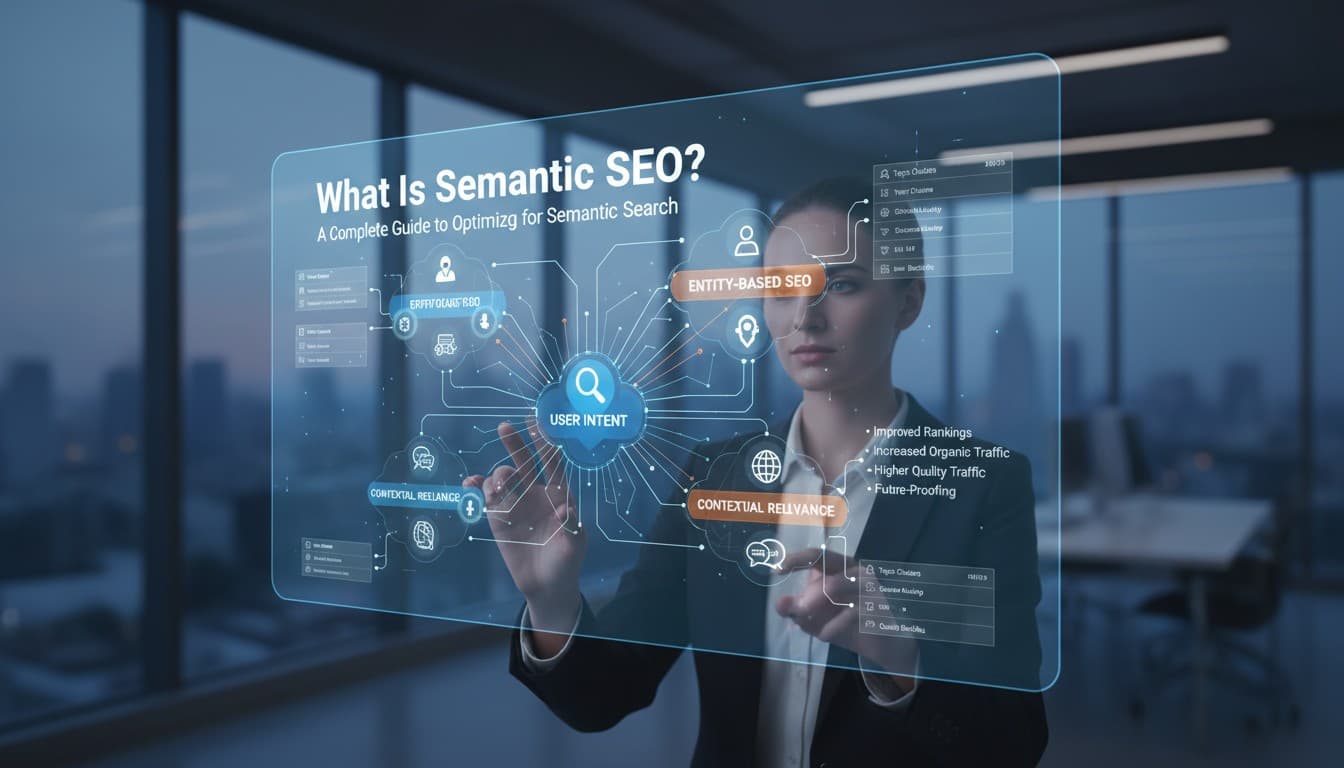
Imagine you ask a friend, "What's the best place to eat in London?" They wouldn't just repeat "London restaurants." Instead, they might ask, "What kind of food are you in the mood for?" or "Are you looking for something fancy or casual?" They understand the meaning behind your question and the intent you have.
This is the core idea of semantic SEO.
Semantic SEO is about making your content understood by search engines the way a person understands it. It moves beyond just matching keywords. It's about helping search engines grasp the full meaning, context, and relationships of words on your page, just like your smart friend does.
The word "semantic" simply means "related to meaning in language or logic." So, semantic SEO is all about optimizing your content for meaning.
It's More Than Just Keywords
In the past, SEO often focused on finding keywords and putting them into your content many times. If you wanted to rank for "best coffee machine," you'd use that exact phrase over and over. This was keyword-based SEO.
But search engines like Google got smarter. They realized that repeating keywords didn't always lead to the best answers. Sometimes, content with many keywords wasn't actually helpful. They started to look at the whole picture.
Understanding User Intent
A big part of semantic SEO is user intent. This means understanding why someone is searching. Are they looking for information? Do they want to buy something? Are they trying to find a specific website?
- If someone searches "apple," are they looking for the fruit, the tech company, or a recipe?
- If they search "how to fix a leaky faucet," their intent is to find instructions.
Semantic SEO helps search engines connect your content to the user's true intent, not just the words they typed.
The Role of Context and Entities
Search engines now use context to understand meaning. They look at all the words around a keyword. They also identify entities. Entities are like specific things in the real world: people, places, organizations, ideas, events.
For example, "Barack Obama," "Eiffel Tower," and "Artificial Intelligence" are all entities. Search engines build connections between these entities in what's called a Knowledge Graph. You might have seen these as information boxes directly in search results (like a quick fact about a famous person or a local business).
Google and other search platforms constantly work to improve their understanding of entities and their relationships. This helps them answer complex questions and provide more relevant results. You can read more about how search engines try to understand the world on the Google Search Developers Blog.
Why This Matters for Your Brand
For your brand, semantic SEO means creating content that fully answers questions and covers topics in a deep, helpful way. It's about being an authority on a subject.
When search engines understand your content well, they are more likely to show it to people who truly need it. This can lead to more visibility for your brand. Tools that track your brand's presence in AI answers, like MeasureLLM, can show you how well AI platforms understand your brand and its key concepts. This is part of understanding your overall AI Visibility.
In short, semantic SEO is about moving from "what words are on the page?" to "what does this page mean?" and "how does it help the person searching?" It’s a shift towards quality, relevance, and a deeper understanding of human language.
How Search Engines Understand Meaning: The Mechanics of Semantic Search
Now that we know what semantic SEO is, how do search engines actually do it? How do they move past just matching words to truly understanding what you mean? It’s a complex process that combines massive databases, advanced computer programs, and artificial intelligence.
Think of it like this: traditional search was like a librarian looking only for books with specific words on the cover. Semantic search is like a super-smart librarian who knows what every book is about, who wrote it, who read it, and how it connects to other books.
Building a Web of Knowledge: Knowledge Graphs and Entities
At the heart of semantic search is the concept of a Knowledge Graph. Imagine a giant mental map for the search engine. This map doesn't just list words; it lists real-world "things" or entities. These entities can be people, places, organizations, ideas, events, or objects.
For example, "Eiffel Tower" is an entity. "Paris" is another. The Knowledge Graph connects them, showing that the Eiffel Tower is located in Paris. When you search for "tallest building in Paris," the search engine doesn't just look for those words. It looks for the entity "Paris" and then the entity that represents the "tallest building" associated with it.
This shift from "strings" (keywords) to "things" (entities) is vital. It allows search engines to understand concepts even when the exact words aren't used. To dive deeper into how AI uses these concepts, read our post on ChatGPT entities and AI knowledge panels for SEO.
Unpacking Entities: Attributes and Relationships
Entities aren't just isolated points on a map. They have details and connections:
- Attributes: These are the properties or characteristics of an entity. For the "Eiffel Tower" entity, attributes would include its height, the year it was built, its architect, and its location.
- Relationships: These describe how entities connect to each other. The Eiffel Tower is located in Paris. Gustav Eiffel designed the Eiffel Tower. These links help paint a complete picture.
When you search, the engine uses these attributes and relationships to find the most relevant information. It's not just about finding text that contains "Eiffel Tower"; it's about finding information that correctly describes its attributes and relationships to other entities.
The Power of Context
Words can mean different things depending on how they are used. Think of the word "bank." Does it mean a financial institution, or the side of a river? Search engines use context to figure this out.
They analyze all the words around a keyword or entity. If your content talks about "deposits" and "interest rates," the search engine knows you mean a financial bank. If it mentions "fishing" and "water," it understands you mean a river bank. This contextual understanding helps search engines deliver much more accurate results, even for tricky queries.
Understanding User Intent
Ultimately, all these mechanics serve one main purpose: to understand user intent. This means figuring out what the person really wants to achieve or find when they type a query.
Are they looking for information (informational intent)? Are they trying to buy something (transactional intent)? Are they looking for a specific website (navigational intent)? Or perhaps they want to compare options (commercial investigation intent)?
By understanding entities, their attributes, relationships, and the overall context, search engines can guess what you're trying to do. They can then show you the most helpful results for your specific need, not just a page with matching words.
The Role of AI in Semantic Search
Modern search engines rely heavily on artificial intelligence to power this semantic understanding. Tools like Google's RankBrain, BERT, and MUM, along with large language models (LLMs), have drastically improved how machines process human language.
These AI systems can:
- Process natural language: They understand queries written in everyday language, not just keywords.
- Identify nuances: They pick up on subtle meanings, synonyms, and related concepts.
- Connect dots: They draw connections between disparate pieces of information, just like a human brain.
This continuous advancement in AI means search engines are getting better and better at interpreting meaning, making semantic SEO more important than ever. To learn more about how generative AI changes search, check out our insights on what AI search is and how it's changing SEO.
These advancements also affect how brands appear online. Tools like MeasureLLM track brand mentions not just as simple word matches, but by understanding the context and sentiment around your brand as an entity in AI-generated answers. This means the AI isn't just counting words; it's understanding what is being said about you.
For more on how search engines use Knowledge Graphs, you can refer to information on Wikipedia.
Semantic SEO vs. Traditional Keyword SEO: An Evolutionary Leap
For a long time, SEO was mostly about keywords. You'd pick a word or phrase, then make sure it appeared enough times on your page. This was "traditional keyword SEO." It worked well when search engines were simpler. But search has grown up a lot. Today, it's less about matching words and more about understanding ideas. This is where semantic SEO shines. It's not just a new trick; it's a fundamental change in how we think about content and search.
Let's look at the key differences between these two approaches.
The Old Way: Keyword Matching
Traditional keyword SEO focused on specific words and phrases. Think of it like a library system that only understands exact book titles. If someone searched for "best Italian restaurants in New York City," your goal was to have that exact phrase, or very close variations, on your page.
- Focus: Exact keywords and their close variations.
- Content Goal: Rank for specific terms. You might try to include the keyword in the title, headings, and a certain number of times in the body text (sometimes called "keyword density").
- How Search Engines Understood It: Search engines primarily looked for matching words in a user's query and the content on a webpage. If the words matched, the page was considered relevant.
- User Experience: This approach could sometimes lead to content that felt unnatural or repetitive, as writers focused on keywords over readability.
The New Way: Meaning and Intent
Semantic SEO is much smarter. It's about understanding the entire meaning behind a search query and the context of your content. Imagine that library system now understands topics, authors, genres, and even relationships between different books. When someone searches for "best Italian restaurants in New York City," a semantic search engine doesn't just look for those words. It understands:
- "Best" means the user wants high-quality recommendations.
- "Italian restaurants" refers to a type of cuisine and dining establishment.
- "New York City" is a specific location.
- It also knows about related concepts, like "trattoria," "pasta," "pizza," "reservations," "neighborhoods," and "reviews."
This deeper understanding allows search engines to connect users with the most helpful, comprehensive answers, even if the exact keywords aren't present. For more on how AI has changed search, check out our guide on traditional SEO vs. Generative Engine Optimization.
- Focus: User intent, overall topic, related concepts, and the relationships between ideas (entities).
- Content Goal: Provide comprehensive, authoritative answers to a user's underlying question. You aim to be the best resource for a whole topic, not just a single keyword. This means covering subtopics, answering common questions, and using natural language.
- How Search Engines Understood It: Modern search engines use advanced AI like Natural Language Processing (NLP) to understand the full meaning of queries and content. They build knowledge graphs (like Google's Knowledge Graph) to map out real-world entities and their connections. This helps them know that "apple" can mean a fruit or a company, depending on the context.
- User Experience: Semantic SEO leads to much higher quality content. It's more readable, helpful, and directly addresses what users are truly looking for.
Why It's an Evolutionary Leap
The shift from keyword matching to semantic understanding is a huge step forward for several reasons:
- Smarter Search Engines: Search engines like Google are incredibly advanced. They are constantly getting better at understanding human language, much like the large language models (LLMs) used in AI chatbots. They can interpret complex questions and provide nuanced answers. You can read more about how Google's systems work on their Search documentation.
- Better User Experience: Users no longer type short, choppy keywords. They ask full questions. Semantic SEO ensures they find relevant, helpful content that truly answers their queries.
- Future-Proofing: As AI continues to evolve, search will become even more conversational and predictive. Optimizing for meaning and intent now prepares your content for the future of search, including how AI platforms recommend brands and topics. Understanding how AI platforms mention your brand or related concepts is key, and tools like MeasureLLM can help track these mentions.
- Authority and Trust: Content that comprehensively covers a topic and provides genuine value builds authority. Search engines reward sites that are seen as experts in their field.
In essence, traditional keyword SEO was about speaking the search engine's "language" (its limited vocabulary). Semantic SEO is about speaking human language, knowing that the search engine is now smart enough to understand you.
What Exactly Is Semantic SEO? Deconstructing the Core Concept
The world of search is always changing. If you've been in SEO for a while, you know that. We've moved from simply matching keywords to something much smarter. This "smarter" way is called semantic SEO.
But what does "semantic" even mean? Simply put, it's about meaning. When we talk about semantic SEO, we're talking about making sure search engines understand your content the same way a human would. It's not just about the words on the page, but the deeper meaning behind them, the relationships between ideas, and the overall context.
Think of it like this: If you read a sentence, you don't just see individual words. You understand the whole message, the intent of the writer, and how all the words connect. Semantic SEO helps search engines do the same.
Beyond Keywords: Understanding the Full Picture
Traditional SEO often focused on using specific keywords again and again. Semantic SEO goes much further. It pushes us to think about:
- User Intent: What is the person really looking for when they type a query? Do they want to buy something, learn something, or find a specific website? For example, someone searching for "apple" might want to know about the fruit, or they might be looking for the tech company. Semantic search aims to figure that out based on their overall context.
- Entities: These are real-world "things" like people, places, organizations, concepts, or objects. "Eiffel Tower" is an entity. "Paris" is an entity. Search engines connect these entities and understand their relationships.
- Contextual Relevance: What other information on the page or across the web relates to your topic? If you write about "car repair," a semantic search engine expects to see terms like "engine," "mechanic," "oil change," and "brakes" nearby. It uses these related terms to build a full picture of your content's meaning.
- Topic Clusters: Instead of just optimizing for one keyword, semantic SEO encourages you to cover a broad topic completely. This means writing about all related sub-topics and questions a user might have.
This approach helps search engines like Google deliver more accurate and useful results. They want to give users the best possible answer to their question, not just a page that happens to have the right words.
Why Semantic Understanding Matters More Than Ever
In today's search environment, especially with the rise of AI and large language models (LLMs), semantic understanding is critical. These advanced systems don't just scan for keywords. They read and process information much like a human, grasping nuances, relationships, and the overall sentiment of content.
This shift means your content needs to be rich, comprehensive, and truly helpful. It should answer questions fully and connect related ideas naturally. For example, understanding how search engines and LLMs interpret your content's structure and meaning can be crucial. Tools that track brand mentions and sentiment, like MeasureLLM, rely on this deep understanding to show you how AI platforms "see" your brand, going beyond simple keyword counts.
By focusing on semantic SEO, you're not just optimizing for today's search engines, but also for the future of search, where AI plays an ever-growing role in understanding and generating information. Learn more about how structured data can boost your content's visibility with LLMs in our guide on structured data for SEO.
The goal is to provide clear, valuable information that search engines can easily understand, categorize, and present to users. This means moving away from tricks and toward true expertise and helpfulness. For more on the evolution of web understanding, you can explore concepts like the Semantic Web on Wikipedia. It's about building content that truly makes sense, both to algorithms and to people.
What Exactly Is Semantic SEO? Deconstructing the Core Concept
Let's break down what "semantic SEO" really means. Simply put, semantic SEO is about making your content understood not just for the words it uses, but for the meaning behind those words. It focuses on the full context of a user's search query and delivers the most relevant, comprehensive answer possible.
Think of it this way: traditional SEO often focused on keywords. You'd pick a keyword, like "best running shoes," and try to use it often in your content. But modern search engines, powered by advanced AI, are much smarter. They don't just match keywords. They try to understand the user's intent and the relationship between different ideas.
The word "semantic" comes from semantics, which is the study of meaning in language. So, semantic SEO is all about helping search engines grasp the true meaning and context of your content, linking it to related concepts and topics.
Beyond Keywords: Understanding Entities and Relationships
At the heart of semantic search is the concept of entities. An entity is a distinct thing or idea. It could be a person (like "Albert Einstein"), a place (like "Paris"), an object (like "smartphone"), or a concept (like "quantum physics").
Search engines build vast networks of these entities and understand how they relate to each other. For example, when you search for "apple," a search engine doesn't just see the word "apple." It understands that "apple" can be a fruit or a tech company. The other words in your search (the context) tell it which "apple" you mean.
This is where the idea of a Knowledge Graph comes in. Google, for instance, uses a Knowledge Graph to store billions of facts about entities and their connections. This helps it answer questions directly and provide rich information, like the boxes you see on the side of search results. For more on how these interconnected ideas form the backbone of modern search, you can learn about the broader concept of the Semantic Web.
Why This Shift Matters for Your Content
The move to semantic search means that creating content is no longer about just stuffing keywords. It's about providing real value by:
- Answering questions thoroughly: Don't just list facts. Explain concepts in depth.
- Covering related topics: If you're writing about "baking bread," you might also talk about "yeast types," "kneading techniques," and "oven temperatures." These are all semantically related.
- Using natural language: Write like you're talking to a person, not a robot. This helps search engines understand your content's natural flow and meaning.
- Building topical authority: By covering a topic completely and accurately, you show search engines that you are an expert. This helps boost your overall visibility.
For brands, this shift is especially important for how they appear in AI answers. When AI platforms like ChatGPT or Gemini provide answers, they use their own semantic understanding to generate responses. Your brand's "Visibility Score" (a key metric at MeasureLLM) depends heavily on how well these AI models semantically link your brand to relevant topics and queries. If your content is semantically rich and clear, you're more likely to earn mentions and citations. Understanding how AI processes these semantic connections is crucial for improving your brand's presence in these new search environments. You can explore more about how to get your brand noticed in AI answers on our blog.
In short, semantic SEO is about writing for your audience first, focusing on meaning, context, and intent. When you do this, search engines (and AI models) can better understand, rank, and recommend your content.
Actionable Strategies for Implementing Semantic SEO
Understanding what semantic SEO is and why it matters is a great start. Now, let's look at how you can actually put it into practice. These strategies will help your content rank better by making it more useful to both people and search engines.
Deep Dive into User Intent and Journey Mapping
Before you write a single word, think about why someone is searching. This is called user intent. Is the person looking for information, trying to buy something, or just navigating to a specific website?
There are generally four types of search queries:
- Informational: The user wants to learn something (e.g., "how to bake bread").
- Navigational: The user wants to go to a specific website (e.g., "Amazon login").
- Transactional: The user wants to buy something (e.g., "buy running shoes online").
- Commercial Investigation: The user is researching before a purchase (e.g., "best running shoes for flat feet reviews").
By understanding these, you can map out the user's journey. What questions do they have at each step? What information do they need? Addressing these needs precisely will make your content highly relevant.
Mastering Entity-Based Keyword Research and Topic Clustering
Forget just stuffing keywords. Semantic SEO means you focus on entities. An entity is a distinct thing or concept, like a person, place, event, or idea. Instead of just "SEO tips," think about "search engine optimization," "Google algorithms," "content marketing," and "ranking factors" as related entities.
Your goal is to identify core entities and then build comprehensive topic clusters around them. A topic cluster includes a main "pillar page" that covers a broad subject. Then, several smaller "cluster content" pages dive into specific related details. These pages all link to each other, showing search engines how they are connected. This helps establish your site as an authority on a particular subject.
Creating Semantically Rich Content
When you write, aim for full coverage of your chosen topic. This means using a variety of words and phrases that relate to your main subject. Think about synonyms and co-occurring phrases. For example, if you're writing about "dogs," you might also use "canine," "pets," "breeds," "puppies," and "animal companions."
Your content should be clear and easy to read. This is good for both human visitors and search engine bots. Make sure your points flow logically and answer common questions people might have.
Answering 'People Also Ask' (PAA) Questions
Have you ever noticed the "People also ask" box in Google search results? These are common questions related to a search query. By directly answering these questions within your content, you increase your chances of appearing in these valuable snippets. Look at the PAA box for your target keywords and weave those answers naturally into your text.
Leveraging AI Tools for Semantic Analysis
AI tools can be very helpful here. They can analyze your content for semantic gaps, which are areas where your topic coverage might be incomplete. They can also check how well you've covered key entities. For example, tools like MeasureLLM can look at your content and ensure contextual accuracy, making sure your information makes sense to other AI models and search engines. This helps improve your overall visibility in AI-powered search. You can learn more about improving your content's presence in AI search on our blog.
Structuring for Semantic Clarity (On-Page Optimization)
How you organize your page sends strong signals to search engines.
- Clear Heading Hierarchies (H1-H6): Use H1 for your main topic, H2 for major sections, and H3-H6 for sub-sections. This creates a logical flow.
- Strategic Internal Linking: Link to other relevant pages on your site using descriptive anchor text. This helps search engines understand the relationship between your content and helps users find more information.
- Optimized Title Tags and Meta Descriptions: These tell search engines and users what your page is about. Include your main topic and related keywords naturally.
- Image Alt Text: Describe what's in your images. This helps search engines understand the image's content and provides accessibility for visually impaired users.
Leveraging Structured Data (Schema Markup)
Think of structured data, or schema markup, as a way to label information on your page for search engines. It's like giving them a cheat sheet to understand your content better. For instance, you can tell Google, "This is an article," "This is a product," or "These are frequently asked questions."
Common schema types include:
- Article Schema: For blog posts and news articles.
- HowTo Schema: For step-by-step guides.
- FAQPage Schema: For pages with a list of questions and answers.
- Organization Schema: For details about your business.
- Product Schema: For products you sell.
Implementing schema can help your content appear in rich results, like star ratings or carousels, which stand out in search results. You can explore more about different schema types at schema.org.
Building Semantic Backlinks
Backlinks, or links from other websites to yours, are still important. But for semantic SEO, quality and relevance are key. Focus on getting links from authoritative websites that are related to your niche. The anchor text (the clickable text of the link) should also be contextual. It should accurately describe the page it's linking to, rather than just generic phrases.
Continuous Monitoring and Refinement
Semantic SEO is not a one-time task. It requires ongoing effort.
- Analyze User Behavior: Look at metrics like dwell time (how long users stay on your page) and bounce rate (how many users leave after viewing one page). These can tell you if your content is truly meeting user intent.
- Track SERP Features: Pay attention to which of your content appears in PAA boxes or featured snippets.
- Use Tools Like Google Search Console (GSC): GSC provides insights into how Google sees your site. It shows you what queries people are using to find your content and any issues Google found. Integrating GSC with your overall tracking helps you understand your semantic performance. Learn more about our Google Search Console integration.
By regularly reviewing and adjusting your strategy, you can keep your content highly relevant and visible in an ever-changing search landscape.
Essential Tools for Your Semantic SEO Toolkit
To truly master semantic SEO, you need the right set of tools. These tools help you understand content meaning, see how search engines view your topics, and track your progress. They help you move beyond simple keywords to a deeper understanding of what users want.
Here are the main types of tools you will need for your semantic SEO efforts:
Keyword and Topic Research Tools
These tools help you find not just single keywords, but also related topics and questions users ask. This helps you build a full picture of a subject.
- SEMrush and Ahrefs: These platforms are great for finding related keywords, long-tail phrases, and topics your competitors rank for. They also show you questions people ask, which helps you cover a topic completely.
- Google Keyword Planner: This free tool from Google helps you discover new keywords and see how many people search for them. It also suggests related terms, giving you ideas for broader content themes. You can find out more about how keywords fit into search visibility on our site (https://www.measurellm.com/docs/keywords).
Entity and Semantic Analysis Tools
These tools dive into the meaning of your content and how well it covers a topic. They help you ensure your text is clear and rich in relevant entities (people, places, things, concepts).
- MeasureLLM: This platform helps you understand how AI models (like ChatGPT or Gemini) see your brand and content. It analyzes your content for key entities and checks how well it answers questions semantically. This helps you make sure AI understands your message. For example, it can show you your Visibility Score, which measures how often AI platforms mention your brand.
- Surfer SEO and Clearscope: These tools analyze top-ranking content for a specific keyword or topic. They give you suggestions for missing terms, entities, and questions you should include to make your content more semantically complete and competitive.
Structured Data Generators and Validators
Structured data helps search engines understand the meaning behind your content more easily. It can also help you earn rich results in search.
- Schema.org: This is a collaborative community that creates and maintains standard schemas (vocabularies) for structured data. Using their types, you can mark up information on your pages, like recipes, reviews, or events. You can explore the different types of data markup at https://schema.org/.
- Google's Rich Results Test: After you add structured data, you need to check if it works correctly. This free tool from Google shows you if your structured data is valid and if it qualifies for any rich results in Google Search.
SERP Feature Tracking Tools
Semantic SEO aims to get your content to appear in various search engine results page (SERP) features, not just the ten blue links.
- Rank Trackers (like those in SEMrush or Ahrefs): Many rank tracking tools now monitor your visibility in features like "People Also Ask" (PAA) boxes, featured snippets, and knowledge panels. Tracking these helps you see if your semantic efforts are paying off.
- MeasureLLM (for AI platform features): While traditional rank trackers focus on Google SERPs, MeasureLLM tracks your brand's presence in AI platform responses. This is key for understanding your visibility in a new era of search (https://www.measurellm.com/features/visibility-tracking).
Analytics and Reporting Platforms
Once your content is live, you need to know how it is performing. These tools help you understand user behavior and how your semantic efforts affect traffic and engagement.
- Google Analytics: This tool shows you how users interact with your site. You can see which pages they visit, how long they stay, and if they complete goals. This data helps you see if your content truly meets user intent.
- Google Search Console: This platform gives you insights into your site's performance in Google Search. You can see which queries bring users to your site, how often your pages appear, and if there are any technical issues. It helps you understand which semantic topics are driving traffic.
What Exactly Is Semantic SEO? Deconstructing the Core Concept
You've likely heard of SEO, or search engine optimization. It's about helping your website show up higher in search results. But the way search engines work has changed a lot. It's no longer just about stuffing keywords into your content. Today, we talk about semantic SEO.
So, what does "semantic" even mean? Think of it this way: "semantic" relates to meaning. When you hear the word, it's all about understanding what words, phrases, and sentences truly mean, not just what they say on the surface. For a search engine, semantic understanding means grasping the full context and intent behind a user's query. It's about figuring out the real reason someone is asking a question.
In simple terms, semantic SEO is the practice of optimizing your content to help search engines understand its overall meaning, context, and relevance to a user's true intent. Instead of focusing on single keywords, you focus on entire topics, concepts, and the relationships between them.
Moving Beyond Simple Keywords
In the early days of search, SEO was often about repeating specific keywords. If you wanted to rank for "best coffee maker," you'd use that exact phrase many times on your page. This was a keyword-driven approach.
But search engines got smarter. They realized that people don't always use the exact same words. Someone might search for "coffee machine recommendations," "top rated espresso maker," or "how to brew great coffee at home." All these queries point to a similar need, but use different words. A basic keyword match would miss the connection.
Search engines now use advanced techniques to understand these connections. They look at synonyms, related concepts, and the overall context of your content. For example, if your page talks about "beans," "grinders," and "barista skills," a search engine knows you're talking about coffee, even if you don't repeat "coffee" a hundred times. This is why tools that track how keywords relate to topics are important, like how MeasureLLM helps analyze keywords and their broader relevance in AI responses (you can learn more about how we handle keywords on our keywords documentation page).
Understanding User Intent
The core of semantic SEO is user intent. This means understanding why someone is searching. Are they looking for information (for example, "what is semantic SEO")? Are they trying to buy something (for example, "buy noise-cancelling headphones")? Are they looking for a specific website (for example, "Google Maps")?
Search engines want to provide the most helpful answer possible. To do this, they need to understand the intent behind the search. If your content truly answers the user's question or meets their need, it's more likely to rank well. This is a huge shift from simply matching words.
Entities and Relationships
How do search engines get this deep understanding? They use something called entities. An entity is a distinct thing or concept. This could be a person (Albert Einstein), a place (Paris), an object (smartphone), an event (Olympic Games), or even an abstract idea (democracy).
Search engines build vast networks of these entities and the relationships between them. This is often called a "knowledge graph." For example, Google knows that "Eiffel Tower" is an entity, and it's located in "Paris," which is also an entity. It knows "Paris" is the capital of "France."
When you create content for semantic SEO, you're not just writing words. You're trying to clearly communicate about entities and their relationships. You're building a rich, interconnected web of information that mirrors how search engines understand the world. This helps your content become a valuable resource for specific topics.
Consider this: if you write about "apple," a traditional search might not know if you mean the fruit or the company. Semantic search, however, looks at the surrounding words. If you mention "iPhone," "Tim Cook," and "macOS," it understands you mean Apple Inc. If you talk about "orchards," "pies," and "healthy snacks," it knows you mean the fruit. You can find a simple definition of "semantics" on sites like Merriam-Webster (see: https://www.merriam-webster.com/).
By clearly defining these entities and their connections in your content, you make it much easier for search engines (and now, Large Language Models like ChatGPT or Gemini) to understand your topic completely. This also improves your chances of showing up in relevant AI answers. For instance, MeasureLLM can help you track your brand's overall visibility in these AI platforms, ensuring your content is effectively contributing to your presence (learn more about visibility tracking here).
The goal is to provide a complete, authoritative resource on a topic. When you do this, search engines see your content as highly relevant and helpful, leading to better rankings and more organic traffic.
Embrace Semantic SEO for Lasting Success
We have journeyed through the evolving world of search, moving from simple keyword matching to a deeper understanding of language. Semantic SEO is not just a buzzword. It is a fundamental shift in how search engines, and increasingly, AI platforms, understand and deliver information. It means thinking beyond exact phrases and instead focusing on the meaning, context, and user intent behind every search query.
At its heart, semantic SEO works by connecting ideas and concepts. Search engines build vast knowledge graphs. These graphs show how different entities (people, places, things, ideas) relate to each other. When you optimize for semantic search, you are helping these engines connect the dots for your content. You are telling them, "My content isn't just about this one keyword. It's about this entire topic, and here's how it fits into the bigger picture." This approach helps your content appear for a wider range of related searches. It ensures you reach users who might phrase their questions in many different ways, but all share the same underlying need for information.
The importance of semantic optimization cannot be overstated in today's digital world. Search engines are getting smarter every day. They are powered by advanced AI and large language models (LLMs) that mimic human understanding. This means the old ways of just stuffing keywords into your content no longer work. In fact, they can hurt your rankings. The new paradigm demands that you serve the user's intent fully and comprehensively. This shift isn't just about pleasing algorithms. It's about providing real value to your audience. When you give users the complete, accurate, and relevant information they seek, they are more likely to engage with your brand.
Building a robust, future-proof SEO strategy means embracing this change. Your goal should be to create content that answers user questions thoroughly. Think about all the related questions a user might have after their initial query. Cover those topics within your content. Use synonyms, related terms, and break down complex ideas into simple language. This comprehensive approach signals to search engines that your content is an authoritative resource on a given topic. It helps you stand out in a crowded online space.
For example, when AI platforms like ChatGPT or Gemini provide answers, they draw on a huge pool of information. If your brand's content is semantically rich, it has a better chance of being understood and cited by these platforms. Tools like MeasureLLM can help you track how your brand is seen by AI, giving you a "Visibility Score" to see where you appear in AI-generated answers. Understanding your brand's presence in these new search environments is crucial for staying ahead. You can learn more about how to track this on our Getting Started guide.
The future of search is here, and it's deeply semantic. As AI continues to evolve, its ability to understand complex language and nuanced intent will only grow. Adapting your SEO strategies now ensures you're not left behind. Begin implementing semantic principles today. Focus on deep understanding, comprehensive content, and user intent. By doing so, you can unlock higher visibility in both traditional search and AI-driven answers, enjoy better user engagement, and achieve sustained organic growth for your brand. This strategic shift is not just good for SEO; it's good for your audience and your business. For further reading on how search engines work, you can visit Google's "How Search Works".